Single-Carrier vs Multi-Carrier Shipping: Which Is Right for Your Business?
September 21, 2026 13 min read

There is no universally better strategy. Using a single-carrier, you get great volume-based discounts in exchange for simplified operations. Whereas choosing a multi-carrier strategy trades that simplicity for the ability to match different shipments to different carriers on cost, service, or destination — at the cost of more integrations, more pickups, and more invoices to manage. Many ecommerce businesses land somewhere in between: one primary carrier for most volume, with a tested secondary carrier for specific situations. So choosing a correct strategy for your business really depends on a number of factors like your shipment profile, your destinations, your negotiated rates, and how much operational complexity your team can absorb.
Single-Carrier vs Multi-Carrier Shipping: What's the Difference?
What is a single-carrier shipping strategy?
A single-carrier strategy means the large majority of your outbound orders move through one carrier account and network — one contract, one set of shipping labels, one tracking system, one pickup schedule. Operationally, that tends to bring:
- Fewer carrier-specific workflows for warehouse staff to learn
- One manifest process and one label format
- Simpler invoice auditing, since every charge comes from a single carrier
- One claims and customer-support escalation path
- Volume concentrated with one provider, which matters for negotiated pricing
It's worth being precise about what this does and doesn't buy you. Single-carrier doesn't automatically mean simple fulfillment overall — a large shipper can still be juggling multiple services (ground, expedited, Saturday), multiple package types, and a complex negotiated contract with one carrier. What it reduces is the number of carrier-specific systems and relationships you need to manage.
What is a multi carrier shipping strategy?
A multi-carrier strategy uses two or more carriers and selects between them based on shipment characteristics — destination, package dimensions and weight, required service level, address type, or cost. The goal is to route each shipment (or cohort of shipments) to whichever carrier handles it best.
A common misconception is that this means someone in your warehouse manually comparing carrier websites for every order. In practice, most businesses that ship at any real volume automate this with shipping software: shipment data is passed to connected carriers, available rates and services are compared, and a routing rule (or a rate-shopping engine) determines which carrier and service to use before a label is generated.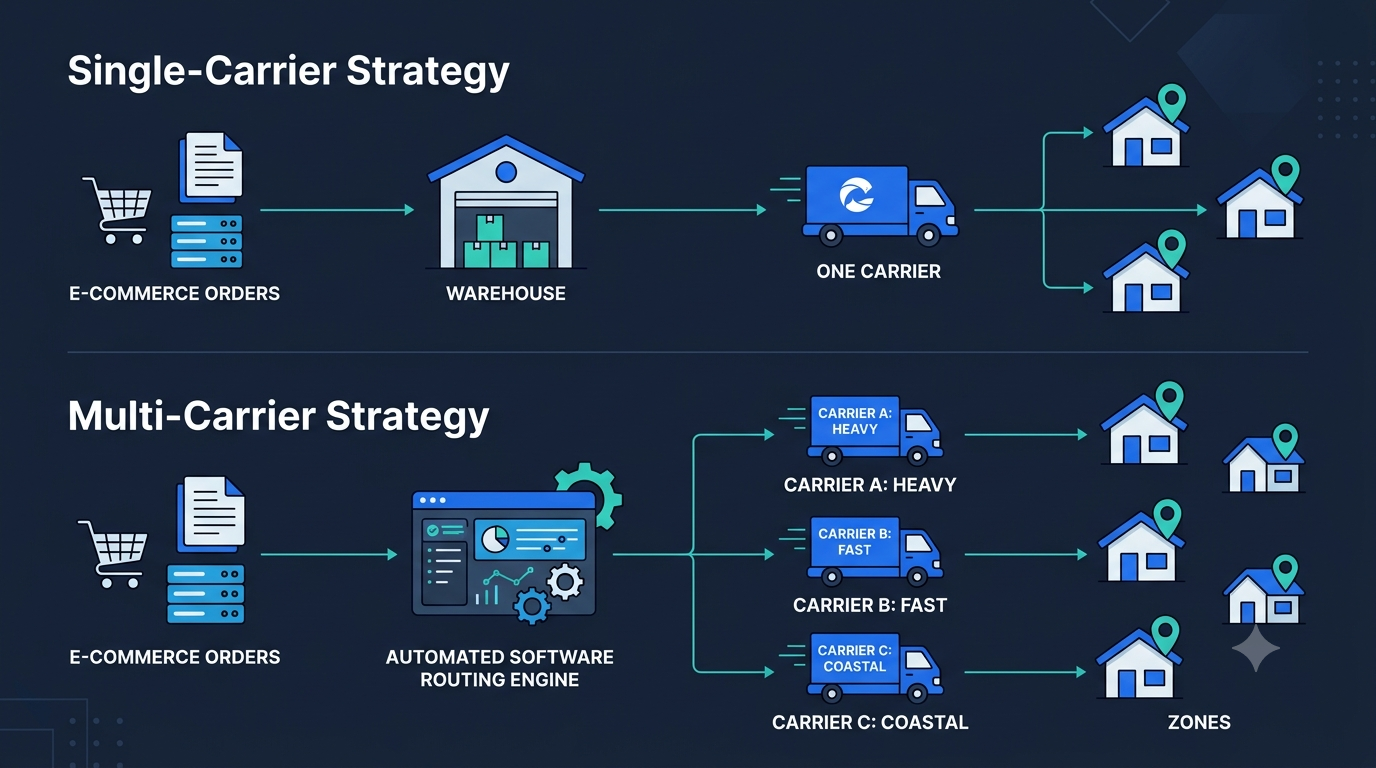
When Does a Single Carrier Make Sense?
Your shipments are relatively consistent
If most of your packages are similar in weight and dimensions, ship primarily to one type of destination (say, U.S. residential addresses), and typically need the same delivery speed, there's less inherent benefit to routing between carriers — there isn't much variation for a second or third carrier to optimize around. A catalog of near-identical small parcels going to similar zones is the profile where single-carrier economics tend to look most attractive.
Operational simplicity matters more than carrier-level optimization
For smaller teams, fewer carrier-specific workflows means less onboarding, fewer integrations to maintain, one pickup to coordinate, and one billing and claims process to audit. That said, shipping software has changed this trade-off somewhat: a platform that connects multiple carriers can absorb a lot of the manual complexity, so it's not accurate to assume multiple carriers automatically create extra work at every packing station. The complexity shows up more in setup, routing-rule maintenance, and invoice reconciliation than in a warehouse worker's daily routine.
Your negotiated carrier pricing is already competitive
This is the point businesses most often skip: don't assume another carrier is cheaper — check your actual billed cost. Volume discounts, minimum spend commitments, and rebate thresholds are tied to concentrated shipping volume. If you're already receiving strong negotiated rates because of your volume with one carrier, splitting that volume elsewhere could put those tiers at risk before you've confirmed the alternative is genuinely cheaper once fuel surcharges and accessorials are factored in.
When Does Multi Carrier Shipping Make Sense?
Your orders have very different package profiles
A catalog that spans lightweight parcels, heavier items, large-dimensional packages, or irregular/non-conveyable shapes creates different carrier economics for different products. This is largely a function of dimensional (DIM) weight — a calculated weight based on a package's volume rather than its actual weight, used when it results in a higher billable charge. Carriers apply DIM pricing differently: USPS Ground Advantage applies DIM pricing above 1 cubic foot using a 139 divisor, while UPS's divisor depends on the rate type — 139 for Daily Rates, 166 for Retail Rates — so it's worth checking which applies to your account rather than assuming one number. The practical takeaway isn't "switch carriers" so much as recognizing that a carrier that's economical for your small-parcel volume may not be the best (or even eligible) option for your oversized items.
Your customers are spread across different destinations
Carrier pricing and service availability vary by destination in ways that matter more as your customer base spreads out:
- Zone pricing — cost is based on the distance between your origin and the delivery ZIP code
- Residential vs Commercial delivery — residential surcharges and delivery-area fees can meaningfully raise the cost of consumer deliveries compared with business addresses
- P.O. Boxes — some carriers flag these for possible delays or exclude them from service guarantees
- Military addresses — USPS natively supports APO/FPO/DPO formatting, while FedEx and UPS documentation states they don't deliver to U.S. military post office addresses. If any share of your customers use these addresses, carrier choice isn't just a cost decision — it's an eligibility one
- Remote areas — Alaska, Hawaii, and non-contiguous U.S. territories often carry extended-area fees that vary by carrier
You need different delivery speeds
If you offer a mix of economy, ground, expedited, overnight, or Saturday delivery, having more than one carrier gives you more eligible services to weigh against each promise. This isn't about one carrier being universally "faster" — published transit times are separate from any contractual money-back guarantee, and guarantee coverage varies by service and can change, so it's worth checking current terms rather than assuming a guarantee applies.
You need a backup when your primary carrier has a problem
Carrier disruptions happen — labor actions, IT outages, facility closures, severe weather, or capacity constraints during peak season. Here's an important distinction: simply having a second carrier account isn't the same as having operational resilience. A backup only helps if it's already integrated, has active labels and pickup routines, and your team knows how to use it — not something added reactively in the middle of a disruption.
How Much Does Multi Carrier Shipping Actually Save?
This is the honest answer: it depends, and it isn't guaranteed. Multiple carriers create the opportunity for savings — they don't automatically produce it.
Compare total billed cost, not published rates
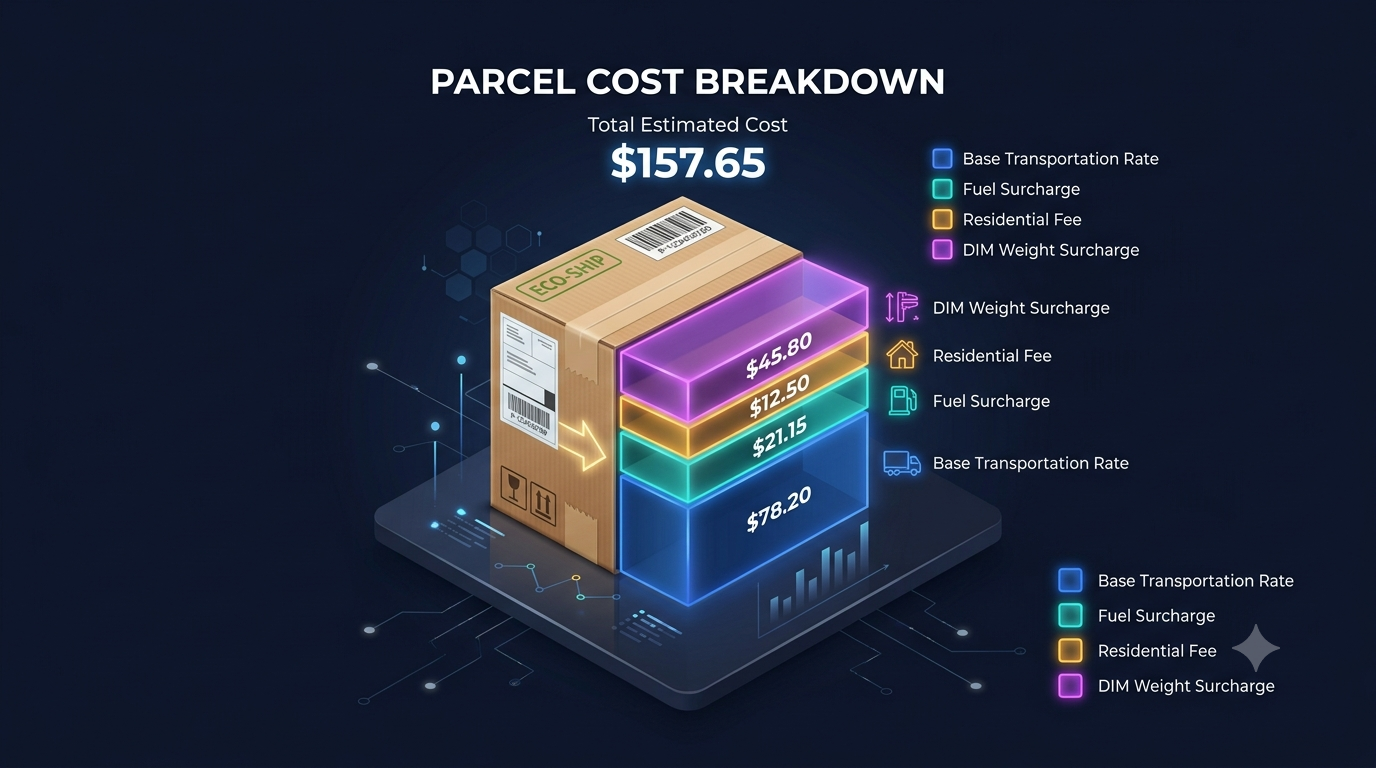
The number on a carrier's rate card rarely matches what you actually pay. A realistic comparison needs to include:
Cost component | What it covers |
|---|---|
Base transportation charge | The core rate before discounts/surcharges |
Negotiated discount | Your contract-specific reduction off the base rate |
Fuel surcharge | A variable charge tied to fuel pricing — often applied to accessorials too, not just the base charge |
Residential / delivery-area fees | Extra charges for certain address types or zones |
Additional-handling / oversize fees | Triggered by package shape, size, or non-conveyable packaging |
Minimum charge | The floor rate a shipment is billed at regardless of calculated weight |
Peak-period surcharges | Seasonal charges that may apply during high-volume periods |
This full picture is sometimes called the landed parcel cost — what a shipment actually costs after every applicable charge, not the headline discount a carrier advertises.
Splitting volume can change your carrier pricing
Volume commitments and rebate tiers are usually built around concentrated spend. Splitting shipments across carriers can dilute those tiers or cause you to miss a minimum commitment — but that's not a reason to avoid multi-carrier shipping outright. It's a trade-off to model: potential savings from better carrier and service selection versus the value of the volume incentives you'd be spreading thinner. The only way to know which side wins is to run the numbers against your own shipment data.
Shipping cost isn't the only cost
A cheaper label on a given shipment doesn't automatically mean lower fulfillment cost. Warehouse labor for sorting and staging, shipping software or licensing fees, invoice-auditing time, claims handling, returns, and delivery exceptions all factor into what a shipping strategy actually costs a business to run. A carrier that's marginally cheaper per label but generates noticeably more delivery exceptions or address corrections can end up costing more in labor and customer support than it saves in postage.
What Should You Compare Before Choosing a Carrier Strategy?
Before committing to either model — or a hybrid — it helps to work through your own data rather than general assumptions.
Analyze your shipment profile. Pull historical shipments and break them down by actual weight, dimensions, DIM weight, packaging type, origin and destination ZIP, residential vs commercial flag, special address type, and required delivery speed. This tells you whether your catalog is homogeneous (favoring single-carrier) or genuinely diverse (favoring multi carrier).
Look at your destination mix. How much of your volume goes to urban vs rural ZIPs, residential vs commercial addresses, Alaska/Hawaii, P.O. Boxes, or military addresses? Concentrated, uniform destinations favor simplicity; a wide geographic spread creates more room for carrier-specific advantages.
Evaluate your operational capacity. Can your warehouse handle multiple carrier pickups and separate staging if needed? Does your shipping software or WMS/OMS support the carriers you'd add? Who would own routing rules and invoice audits day to day?
Evaluate service performance, not just price. On-time delivery, transit consistency, damage and loss rates, delivery exceptions, and tracking quality all affect your actual cost of doing business — a marginally cheaper carrier that creates more exceptions can be more expensive to operate with.
Single Carrier vs Multi-Carrier: Practical Examples
The examples below are illustrative — hypothetical business profiles meant to show how the factors above interact, not case studies of real companies.
A small, predictable operation.
Imagine a business shipping a moderate, steady volume of similar-sized packages, almost all to U.S. residential addresses, with one standard delivery promise. There isn't much variation across those shipments for a second carrier to meaningfully optimize, and the operational overhead of adding one may not be worth it yet. That doesn't mean single-carrier "wins" — only that this business has less to gain from the added complexity right now.
A catalog with mixed package sizes.
Picture a retailer selling small accessories alongside heavier or bulkier items. A single carrier might offer strong pricing on the small-parcel volume that makes up most orders, while being comparatively expensive — or restrictive — for the oversized subset. This is a case where routing by package profile, rather than switching carriers entirely, can make sense.
A seller with geographically diverse customers.
Consider a business whose orders span dense urban ZIPs, rural addresses, and a meaningful share of P.O. Box or military-address orders. Zone pricing, residential surcharges, and address-type eligibility all vary enough across that spread that evaluating more than one carrier is worth the effort, even if most volume still goes through one primary provider.
A growing business adding a tested backup.
A business shipping mostly through one primary carrier decides to formally test and integrate a second carrier for defined situations — oversized items, a specific remote region, or peak-season overflow — rather than switching entirely. The primary carrier still handles the bulk of predictable volume, which protects existing pricing tiers, while the secondary option is ready if it's needed.
What Role Does Shipping Software Play in a Multi Carrier Strategy?
Managing carrier connections from one workflow. A multi-carrier shipping software can centralize carrier accounts, incoming orders, available rates, shipping labels, and tracking data in one place, rather than requiring separate logins and processes per carrier. The specific capabilities vary by platform, so it's worth checking what a given tool actually supports before assuming it covers everything below.
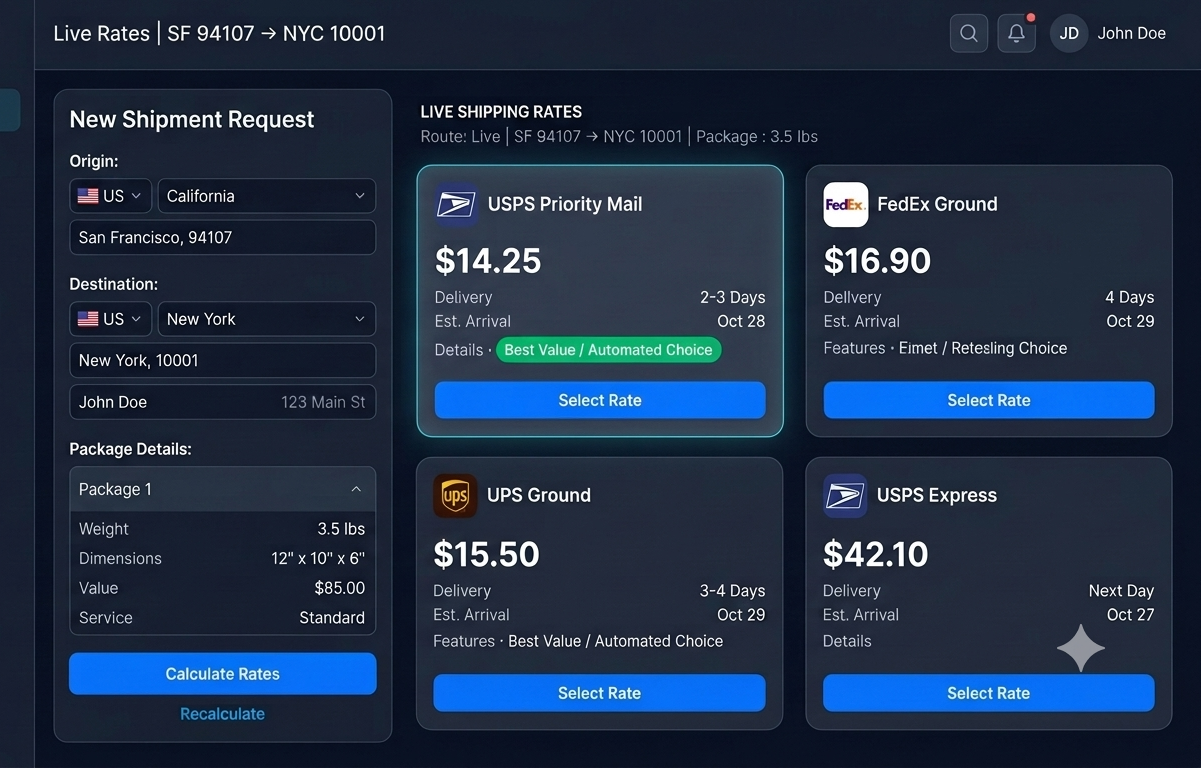
Comparing carrier options before buying a label. This is often called rate shopping: shipment details are sent to connected carriers, the available services and rates are compared, and a rule (or the lowest qualifying rate) determines which carrier's label gets generated.
Automating carrier selection. Rather than a person choosing a carrier manually, routing rules can be built around weight, dimensions, destination, service requirement, or package type — for example, sending lightweight residential orders one way and oversized items another.
Keeping the warehouse workflow simple. This addresses a common concern directly: using multiple carriers doesn't necessarily mean warehouse staff have to operate several separate systems. A shipping platform can potentially provide a single interface for generating labels across every connected carrier, which is where much of the practical value of multicarrier software comes from.
What About Returns, Tracking, and Customer Experience?
Returns. Outbound shipping isn't the whole picture. Who handles return-label generation, whether labels are prepaid, how convenient drop-off is for the customer, and what return transit costs all affect the customer experience and your bottom line. With multiple carriers, it's worth deciding deliberately whether returns follow the same carrier as the original outbound shipment or a separate process — the two don't have to match.
Tracking and delivery notifications. Each carrier exposes its own tracking events and terminology. With one carrier, tracking data is consistent by default. With multiple carriers, that consistency has to be built — either by the shipping platform normalizing the data or by accepting some variation in how tracking looks to the customer depending on which carrier handled a given order.
Exceptions and claims. Lost packages, damage, and address problems happen with any carrier. Diversifying carriers gives you more options if one has a bad stretch, but it also means learning and managing more than one claims process and set of exception rules.
Should You Use One Carrier or a Primary Carrier With Alternatives?
For many ecommerce businesses, the realistic answer isn't a strict either/or. A primary-carrier model with qualified alternatives routes the large majority of predictable volume through one carrier — preserving negotiated pricing and operational simplicity — while keeping one or two tested secondary carriers available for specific, defined situations: oversized items, particular remote destinations, peak-season overflow, or disruption recovery.
The word doing the most work here is tested. An alternative carrier that isn't already integrated, doesn't have active labels and accounts set up, and hasn't been used in a real shipment isn't a meaningful backup — it's just an unused account. If you go this route, the value comes from testing the alternative before you need it, not from having it on paper.
Questions to Ask Before You Decide
- Do we have enough shipment diversity (package types, destinations, service levels) for a second carrier to meaningfully help?
- Are our actual billed costs different across our package and destination types, based on real shipment data — not assumptions?
- Would splitting volume put our negotiated pricing or minimum commitments at risk?
- Can our shipping software or WMS support the carriers we'd be adding?
- Can our warehouse handle additional pickups, staging, and sorting without significant disruption?
- Do we need a reliable, tested backup carrier for disruption scenarios or peak overflow?
- How much do returns, tracking consistency, and delivery options matter to our customers specifically?
- If we already have a backup carrier, has it actually been tested — labels, accounts, and pickup routine included?
Quick Decision Guide
If your business… | Consider evaluating… |
|---|---|
Has predictable, uniform shipment profiles | Single-carrier economics |
Ships a wide mix of package sizes and shapes | Multi carrier options |
Ships to highly varied destinations (urban/rural, P.O. Box, military) | Multi carrier options |
Already has strong negotiated pricing with one carrier | Single-carrier economics, before switching anything |
Needs several distinct delivery-speed promises | Multi carrier options |
Wants protection against carrier disruptions | A primary carrier with a tested alternative |
Has limited operational or IT capacity | Weigh simplicity against potential optimization carefully |
Already uses shipping software with multi-carrier support | Automated, rule-based carrier selection |
No column here is "the right answer" — it's a starting point for deciding which variables are worth analyzing with your own shipment data.