How to Set Shipping Rates for Your Online Store: Flat Rate vs. Calculated vs. Free Shipping Threshold
November 03, 2026 22 min read

Learn how to set ecommerce shipping rates with flat-rate, carrier-calculated, and free-shipping threshold strategies. Compare costs and find the right approach for your business.
Shipping rates aren’t the same for every business, so it’s important to find what works for yours. Flat rate shipping works when what it costs you to ship doesn't vary much from order to order. Calculated rates (live quotes from carriers) work better when your orders differ a lot in weight, size, or distance. A free-shipping threshold isn't really a third pricing method. It's a merchandising decision you add on top of either one, and it only pays off if your margins can carry it. Plenty of stores end up using a mix.
Whichever you pick, start in the same place: work out what shipping actually costs you per order, and how much that cost varies. Every decision below depends on that.
This guide is written for stores shipping physical products within the US. International shipping and freight get a short section near the end, with pointers to where to look next.
Shipping rate vs. shipping cost: what you're actually deciding
Two terms get used interchangeably, and mixing them up leads to bad decisions.
- Shipping rate is what your customer pays at checkout.
- Shipping cost is what you pay to get the order delivered: the carrier label, packaging, the labor to pick and pack, and any fees that show up later.
The gap between those two numbers is the real decision. You can choose how customers pay for shipping, but you can't make shipping free. The cost lands in one of three places: on the customer at checkout, inside your product prices, or in your margin. "Free shipping" just means you've chosen one of the last two.
Charging less than it costs you isn't automatically a mistake. Some stores subsidize shipping on purpose to win first orders. It just needs to be a choice you've priced in, not something you discover on a carrier invoice.
Flat rate, calculated, or free-shipping threshold: how each one works
Here's the comparison at a glance. The sections after it explain each model and where it breaks down.
Scenario | Flat rate | Calculated (live carrier rates) | Free-shipping threshold |
|---|---|---|---|
What the customer sees | A fixed charge, or a few tiers | A rate pulled from carriers at checkout | $0 shipping once the order reaches a minimum |
Who absorbs cost variance | You | Largely the customer | You |
Best fit | Similar-sized products, narrow cost spread | Wide range of weights, sizes, or distances | Healthy margins, products customers can bundle |
Main risk | Losing money on heavy or distant orders | Bad product data produces bad quotes; can add checkout friction | Giving shipping away on orders that would have happened anyway |
Setup effort | Easy at checkout, but needs cost analysis behind it | Highest: needs accurate weights and dimensions | Easy technically; needs margin modeling |
Flat rate shipping
With flat rate shipping, you charge a fixed amount for orders that meet rules you define. That could be one fee for every order, a fee per item, or tiers based on weight or order value. For example: $5.99 for orders under $50 and $9.99 above that.
What matters is how widely your shipping costs vary. A store selling small, similar-weight products can often use one rate, because most orders cost roughly the same to ship. It breaks down when the spread gets wide. A $7.99 flat rate might be fine for a T-shirt and lose money on a 20-pound box going several zones away.
Flat rate doesn't remove the math, either. It simplifies checkout, but you still need to know your product weights and what orders actually cost to ship, both to pick a sensible rate and to check later whether it's working.
Your flat rate isn't the same as a carrier's flat-rate product. A flat rate on your store is a price you set. USPS Priority Mail Flat Rate and FedEx One Rate are carrier products with their own packaging, eligibility rules, and pricing. USPS flat-rate packaging charges the same price regardless of destination, subject to its rules; FedEx One Rate is limited to certain Express services. You can use these carrier products to ship orders, but they don't decide what you charge customers.
Calculated (carrier-calculated) shipping
With calculated shipping, your checkout asks carriers such as USPS, UPS, or FedEx for a live rate based on the shipment's origin, destination, weight, dimensions, and service level. The appeal is that the price tracks real carrier pricing, so it handles catalogs where one item weighs a few ounces and another weighs 30 pounds.
It comes with conditions:
- It's only as good as your product data. Every product and variant needs accurate weight and dimensions, and the packing the system assumes has to match what your warehouse actually does. If a customer orders five bulky items and the system quotes one small parcel, you absorb the difference.
- The quote may not be what you pay. Carrier rates vary by account, so the number a customer sees at checkout isn't necessarily the number on your invoice.
- Late or high quotes hurt conversion. Showing a surprising number at the last step is a common way to lose a sale (more on that in Step 4).
- Split shipments add up. On Shopify, for example, calculated rates are worked out per shipment and added together when an order ships in more than one parcel.
- Availability depends on your platform. Some platforms limit third-party carrier-calculated rates to higher-tier plans or charge extra for them. Check what your plan includes.
Free shipping with a threshold
A free-shipping threshold waives shipping once a cart reaches a minimum: "Free U.S. shipping on orders over $75." On most platforms it's not a separate rate engine. On Shopify, for example, it's a rate set to zero or a minimum-order rule.
Think of it as a merchandising and margin decision, not a shipping setting. You set it using your average order value, typical shipping cost, product margin, and how much larger you want baskets to get. Too low, and you give away margin on orders customers would have placed anyway. Too high, and it may not motivate anyone while leaving customers just under the line feeling penalized.
Two practical details. First, some platforms judge the threshold after discounts: on Shopify, price-based rates use cart value after discounts and before taxes, so a shopper with an $82 cart and a $10 coupon is at $72 and may miss a $75 threshold. Second, say which service the free shipping covers and the delivery window, since free standard and free expedited are very different costs.
Hybrids: what many real stores do
You don't have to pick one. A common setup is a flat rate or weight-based tiers for standard parcels, calculated rates for oversized items, and free standard shipping above a threshold. Shopify, for one, supports multiple rate types with conditions. Some stores fold shipping into product prices instead, and subscription businesses often build it into the subscription fee.
Step 1: Find out what shipping really costs you
What goes into the cost of one order
The carrier label is only part of it. A realistic cost per order includes the label, packaging materials, the labor to pick and pack, and the expensive exceptions: returns, address corrections, and carrier surcharges.
You can estimate handling like this:
Handling cost = (hourly labor cost x minutes to pack ÷ 60) + packaging materials
Use a fully loaded labor figure (wages plus payroll taxes and other employment costs), not just the hourly wage. As a hypothetical: at $20 an hour, six minutes to pick and pack, and $0.90 of packaging, handling comes to $2.00 + $0.90 = $2.90.
Here's why it matters. In another hypothetical, a store charges $6.99 flat. The label costs $6.20, but the box, tape, pick-and-pack labor, and the occasional return add $2.75. The real cost is $8.95, so every order loses $1.96 before product margin even enters the picture.
Look at the spread, not just the average
If you have order history, pull a few weeks to a few months of it. If you're new, weigh and pack 10 to 20 typical orders and price them to a few destinations, some near and some far, using carrier rate calculators. Then group the orders by weight band and zone. (A zone is a group of destinations carriers use for pricing, based on distance from where the package ships. Farther zones generally cost more.)
Look at more than the average. Check the median and what the most expensive orders cost. Here's a hypothetical store with 100 orders and a $7.00 flat rate:
Order group | Number of Orders | All-in cost per order | Result at $7.00 flat rate (per order) | Group total |
|---|---|---|---|---|
Under 1 lb, nearby zones | 40 | $5.00 | +$2.00 | +$80 |
Under 1 lb, far zones | 25 | $7.00 | $0.00 | $0 |
1–3 lb, nearby zones | 20 | $7.50 | -$0.50 | -$10 |
1–3 lb, far zones | 15 | $12.00 | -$5.00 | -$75 |
All 100 orders | $7.05 average | -$5 |
These numbers are invented to show the pattern. Your costs will differ.
The average cost is $7.05 and the median is $7.00, so a $7.00 flat rate looks nearly perfect. But 35 of the 100 orders lose money, and 15 of them lose $5 each. The 40 orders that overpay by $2 are the nearby, lightweight ones, which are also the customers most likely to compare your price against someone else's. The average hid all of that.
Package size and dimensional weight
Carriers don't always bill by what a package weighs. They compare actual weight with dimensional (DIM) weight, which reflects the space the package takes up, and generally bill the higher one. USPS, for example, applies DIM weight to certain domestic services for packages over one cubic foot (1,728 cubic inches). Its current formula is length x width x height ÷ 139, with dimensions rounded up. Other carriers have their own rules and divisors, so check the ones for the services you use.
A hypothetical example, using 139 as the divisor: 1.5 pounds of lightweight goods in a 16 x 12 x 10 inch box. That's 1,920 cubic inches, and 1,920 ÷ 139 is about 13.8, so the package could be billed as roughly 14 pounds. That's about nine times its actual weight.
Two practical rules follow. Rate the box you actually ship, not the product on its own. A folded shirt might measure 12 x 9 x 1 inches, but if it goes out in a 14 x 11 x 3 inch mailer with tissue and a card, the mailer is what gets measured. And measure real packed boxes when you build your cost model, because a flat rate that ignores dimensional weight can be wrong on exactly the bulky, light products where it hurts most.
List rates versus what you actually pay
Base postage is rarely the whole bill. Carriers add fees on top, and which ones apply, and how much they cost, differs by carrier and service. Common types include:
- Residential delivery charges
- Delivery area surcharges for ZIP codes that cost more to serve
- Additional handling for long, heavy, or awkward packages
- Oversize or large-package fees
- Fuel surcharges
- Address correction fees
Most direct-to-consumer orders go to homes, so a cost model built on commercial addresses can understate what a typical order costs. Check the current surcharge schedule for each carrier and service you use, since the amounts change.
Also keep in mind that what you pay can differ from published rates depending on your carrier account and how you ship. That's why the most reliable approach is to price your own typical packages to a few real destinations rather than rely on a generic rate chart. If you want to compare carriers for your packages, sign up at Shipkasa for free and check how live carrier rate comparison works, and our guide to cheapest way to ship a package covers which carriers and services tend to suit different parcels.
Step 2: Choose the model that fits your store
A simple way to decide
Start with your cost spread from Step 1, then add margin and order size:
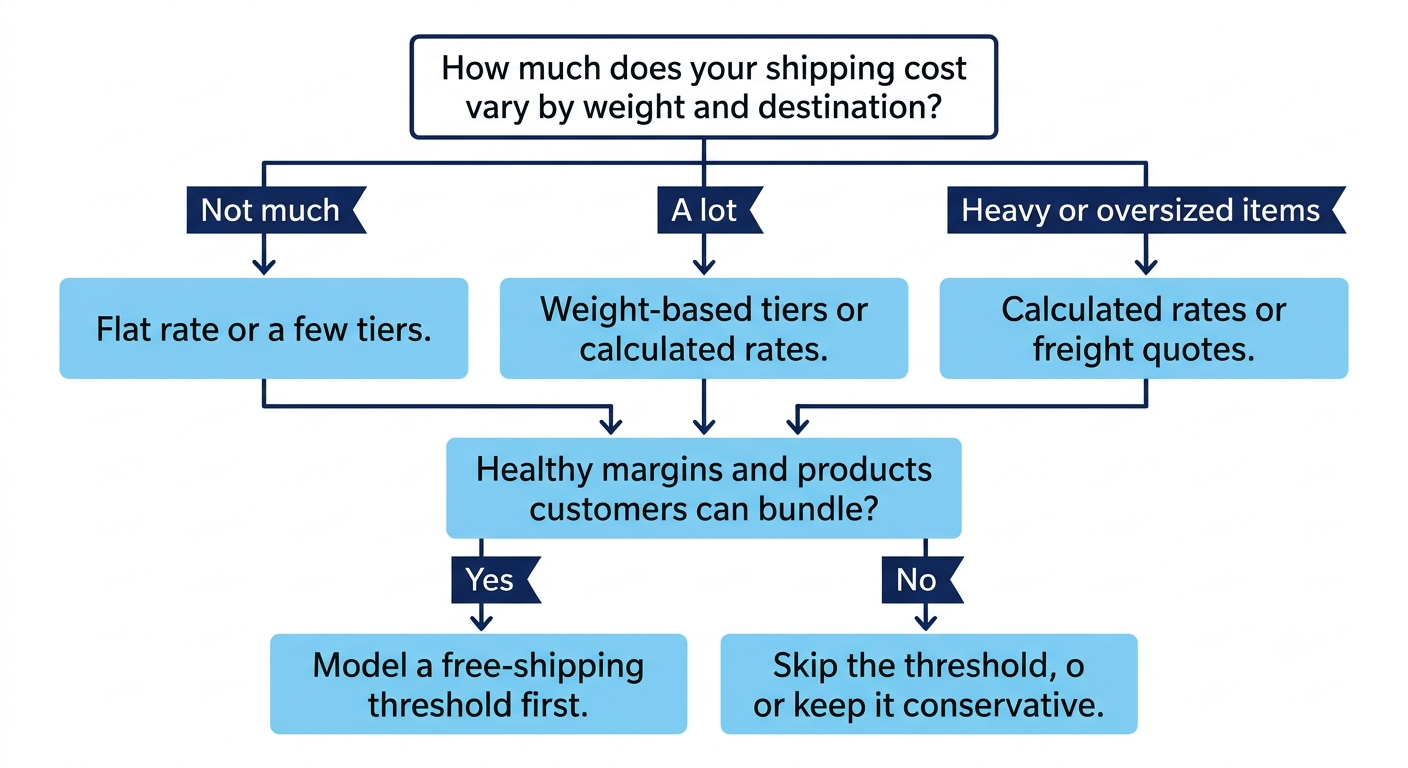
- Light, similar-sized products with a narrow cost spread: flat rate, or a modest free-shipping threshold, often works.
- Heavy or oversized products: calculated rates are usually the safer starting point, because one flat rate can turn unprofitable quickly.
- A wide spread of weights, sizes, and destinations: weight-based tiers or calculated rates.
- Healthy margins and products customers can bundle: a threshold is more likely to pay off, because extra items carry meaningful margin.
- Low margins (some electronics and commodity goods): be careful with free shipping. Model it first, since product margin may not cover the shipping.
- Subscriptions: consider building shipping into the subscription price.
- Local or regional brands: flat rates, local delivery fees, or pickup can beat nationwide carrier-based rules.
Let's take a look at Four store profiles
These are illustrative, not real businesses.
- A small skincare brand shipping similar-sized bottles. Starting point: one flat rate, or a couple of tiers by order value. Watch for: larger multi-bottle orders that weigh more.
- A furniture or fitness-equipment seller. Starting point: calculated rates, because shipping a chair across the country can cost radically more than shipping a small accessory nearby. Watch for: product data accuracy and items that trigger oversize fees.
- An apparel brand with healthy margins. Starting point: a flat rate below a free-shipping threshold, aimed at turning one-item orders into two or three items. Watch for: the break-even math in Step 3.
- A store with a mixed catalog. Starting point: a hybrid, with weight-based or flat rates for standard parcels and calculated rates for oversized goods. Watch for: split shipments and exceptions.
What can change the answer
Your platform may limit which models you can use. A 3PL contract may set its own rates and rules. A delivery promise like "ships in two days" changes your cost structure. A free-returns policy adds shipping cost you may not have counted. And competitors' rates are worth looking at, but copying them blindly is risky, because their costs, margins, and carrier arrangements aren't yours.
Step 3: Set your numbers
Setting a flat rate or tiers
Start with your cost distribution, not a single average. Decide how much subsidy per order you're willing to accept, and on which orders. If the spread is wide, one number won't work, so move to tiers by weight band, destination zone, or order value.
Weight bands usually track real cost better than order-value bands. A $15 cast-iron pan and a $90 scarf can be priced the same by an order-value tier and cost very different amounts to ship. Include handling in the rate, not just postage.
There's a trade-off either way. A lower flat rate is simple and attractive but erodes margin on heavy or distant orders. A higher one protects margin but can suppress conversion, especially on low-value carts.
Setting up calculated rates well
- Keep weights and dimensions accurate for every product and variant.
- Build a packaging matrix (poly mailer, small box, medium box, oversize carton) so the quote matches the package your warehouse will actually use.
- Include packaging weight. On Shopify, weight-based rates add the default package weight to product weight, so set it correctly or every rate runs slightly low.
- Offer one or two service levels rather than a long list.
- Set a fallback rate in case the live quote fails.
- Compare checkout quotes against label and invoice costs regularly.
Setting a free-shipping threshold
A common starting point is a threshold slightly above your current average order value, so customers have a reason to add an item. But an average can hide a lot, so look at the whole distribution of order values: how many orders already sit above your candidate threshold, and how many sit just below it?
That distribution matters because of a cost that's easy to miss. Every order that would have cleared the threshold anyway is pure giveaway. The threshold only pays off if enough orders get pushed over it to make up for that. A simplified version of the math:
Net change = (orders nudged over the threshold x extra margin from the items they add) - (all orders that now ship free x the shipping charge you no longer collect)
Here "extra margin" means what the added items earn after product cost, packaging, and payment fees, not their sale price. And "all orders that now ship free" includes both the orders that were already above the threshold and the ones you nudged over it. In this hypothetical, assume you currently charge shipping that matches your cost:
Shipping | Scenario A | Scenario B |
|---|---|---|
Shipping charged now (and no longer collected) | $8 | $5 |
Orders already above the threshold | 60 | 30 |
Orders nudged over the threshold | 10 | 40 |
Extra margin per nudged order | $12 | $15 |
Extra margin gained | $120 | $600 |
Shipping revenue given up (70 orders each) | $560 | $350 |
Net change | -$440 | +$250 |
Invented numbers, to show how sensitive the result is.
The same threshold can lose money or make money depending on how many orders it actually moves and how much those extra items earn. This math leaves out two things that can matter in your favor, any lift in conversion from free shipping and any repeat purchases, and one that can matter against you, heavier packages costing more to ship. Treat the formula as a way to ask the right question, then test.
A few more rules. If a coupon can drop a cart below the threshold, expect confusion and say so in your policy. Decide in advance how to handle destinations like Alaska and Hawaii. And check how your platform evaluates the threshold before you promise anything.
Where to set this up
Platforms differ, so use your platform's own help documentation. As examples, Shopify lets you set a flat rate to zero or apply a minimum-order rule, and BigCommerce supports flat rates per order or per item, tiers by order total or weight, and fixed shipping prices on individual products.
Step 4: Show shipping costs early and clearly
Baymard Institute's checkout research has found that roughly half of US shoppers who abandon a cart for a stated reason point to extra costs such as shipping, taxes, and fees. The lesson isn't necessarily "make shipping cheaper." It's "don't let it be a surprise."
What helps in practice:
- Show shipping information before checkout. Put it on the product page and in the cart, not only at payment.
- Pair cost with timing. A delivery estimate next to the price justifies the fee, especially if you're charging more for faster service. Be clear about the difference between handling time (how long you take to ship) and transit time (how long the carrier takes after pickup).
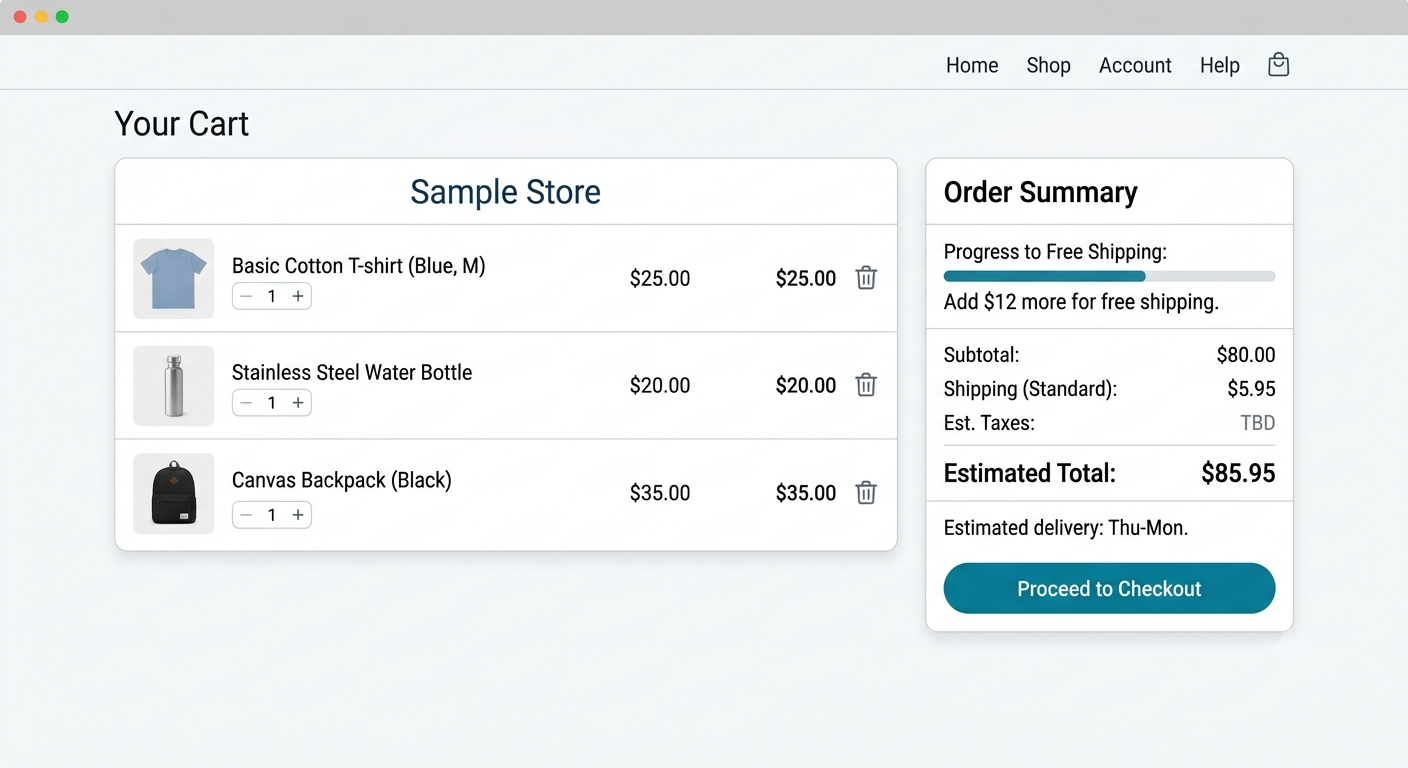
- Show progress toward free shipping. A cart message like "$12 away from free shipping" tells customers exactly what the offer is.
- State what free shipping covers. Name the service and the delivery window.
- Keep a clear shipping policy page. Include exceptions, such as destinations you don't ship to.
Step 5: Track, test, and adjust
The numbers to watch
- Shipping recovery ratio: shipping revenue ÷ shipping cost. If you collect $5,000 in shipping charges against $6,250 in shipping costs, the ratio is 0.80, which means you recover 80 cents of every dollar you spend. Below 1.0 means you're subsidizing, which is fine when it's deliberate.
- Subsidy per order: (shipping cost - shipping revenue) ÷ number of orders.
- Shipping cost as a share of revenue.
- Share of orders that shipped free.
- Quote-versus-invoice variance: the gap between what checkout quoted and what the label and carrier invoice actually cost. Check it especially after carrier rate changes, packaging changes, and product launches.
- Contribution margin per order: revenue minus variable costs such as product cost, shipping, packaging, payment fees, and fulfillment labor. It's the number a shipping policy should ultimately be judged on.
How to test changes
Change one variable at a time: the rate, the threshold, or the delivery estimate you display. Measure conversion, average order value, shipping cost per order, and contribution margin together, because conversion alone can make a money-losing policy look like a win. Give each test enough time to smooth out unusually busy or slow weeks.
When to review your rates
Review monthly at first. After that, review whenever carriers change their rates, your catalog changes, or your packaging changes. Carriers update rates and surcharges on their own schedules, and some add seasonal surcharges, so check their published announcements instead of assuming last year's numbers still hold. Audit carrier invoices too: the label price and the final invoice can differ because of corrections, surcharges, address problems, or measurement adjustments.
Special cases that break the simple rules
- Heavy or oversized items. One flat rate gets unprofitable quickly, and carrier flat-rate boxes aren't designed for large goods. Furniture and major appliances often exceed parcel limits and are cheaper to move as freight.
- Alaska, Hawaii, Puerto Rico, military addresses, and rural areas. These can break a simple national flat rate. Decide whether to charge a separate rate or exclude them, and say so clearly. On some platforms, a destination also has to be assigned to a shipping zone with a rate, or checkout shows that delivery isn't available.
- International orders. This guide covers US domestic shipping. International shipping adds duties, taxes, customs paperwork, carrier availability, and return complications, so domestic-style rules can be risky.
- Split shipments and dropshipping. If an order ships in more than one parcel, or from more than one location, you can end up with multiple labels and charges for what looks like one order to the customer. A rate rule that assumes one shipment can be wrong.
- Subscriptions, local delivery, and pickup. Subscriptions often embed shipping in the price. Local brands may do better with a delivery fee or pickup option than with carrier-based rules.
Common shipping-rate mistakes
- Choosing a flat rate from the average cost. Check the spread.
- Copying a competitor. Use your own cost data.
- Counting only base postage. Add surcharges and handling.
- Rating the product instead of the packed box. Measure what ships.
- Launching a free-shipping threshold without modeling it. Run the break-even math, then test.
- Letting coupons quietly break the threshold. Test your cart with discount codes.
- Setting rates once and never revisiting them. Review on a schedule.
- Assuming calculated rates always protect your margin. Bad data, packing mismatches, and surcharges can still cost you.
- Treating your flat rate and a carrier's flat-rate product as the same thing.
Keeping checkout rates in line with real label costs
A lot of this guide comes down to comparing what you charge with what you pay, and keeping that comparison current. Any shipping software worth using should help with a few things: comparing carrier and service rates for the same package, keeping a record of what each label cost, and making it easy to spot where checkout quotes and actual costs drift apart. Validating addresses before you buy a label also saves you from fees and failed deliveries later.
ShipKasa is a shipping-label and multi-carrier shipping software company. If you want to see what it offers for rate comparison and label costs, start at shipkasa.com to learn more about our product.
Frequently asked questions
What's the best way to set shipping rates for a small online store?
Start by working out your real cost per order, including packaging and labor, and how much it varies by weight and destination. If it varies little, a flat rate can work. If it varies a lot, use weight-based tiers or calculated rates. Add a free-shipping threshold only after modeling whether your margin can support it.
Is flat rate shipping better than calculated shipping?
Neither is better in general. Flat rate is simpler for customers and for you at checkout, but it loses money when costs vary widely. Calculated shipping follows real carrier pricing but needs accurate product data and can create sticker shock late in checkout.
How do I calculate how much to charge for shipping?
Add up the label cost, packaging, and labor for a sample of typical orders going to near and far destinations. Compare the average, the median, and the most expensive orders. Then decide how much of that cost you want the customer to pay and how much you'll cover.
What should my free-shipping threshold be?
There's no universal number. A common starting point is slightly above your average order value, but look at your full order-value distribution and run the break-even math in Step 3 before committing. Then test it.
Does free shipping increase sales?
It can. Unexpected shipping costs are a common reason shoppers abandon carts, and a threshold can raise order values. But it also gives away margin on orders that would have happened anyway, so whether it increases profit depends on your numbers. Test it before assuming.
Should I include shipping in my product prices?
Some stores do, especially to advertise free shipping. The trade-off is a higher sticker price, and you cover shipping on every order, including the heavy or distant ones. It works best when your shipping costs are fairly uniform.
Should I charge customers the carrier's retail rate or my discounted rate?
There's no single rule. With a flat rate you set the price yourself. With calculated rates, what customers see depends on your platform and carrier account. Compare what you quote with what you're actually billed, then decide on purpose whether to keep any difference, pass it on, or cover the gap.
How often should I update my shipping rates?
Review them monthly at first, then after any carrier rate change, catalog change, or packaging change. Compare checkout quotes with real label and invoice costs so you catch drift early.
Before you change anything
- Pull real cost data for a sample of orders, including packaging and labor.
- Look at the spread by weight and zone, not just the average.
- Pick the simplest model that fits that spread, and add a threshold only if the numbers support it.
- Show the cost and delivery estimate before checkout.
- Track recovery ratio and contribution margin, and review on a schedule.