Cheapest Way to Ship a Package in 2026: A Practical Guide for E-Commerce Sellers
October 21, 2026 17 min read

Find the cheapest way to ship a package in the U.S. in 2026. Compare USPS, UPS, and FedEx, understand dimensional weight and surcharges, and follow a practical 30-day cost review.
Last updated: October 20, 2026
Carrier prices and rules change often. Before updating your shipping prices, verify the latest rates and rules with the carrier.
If you’ve searched for the cheapest way to ship a package, you’ve probably noticed that there isn’t a simple answer. The lowest price depends on what you’re sending, how big the box is, where it’s going, and which rates you can access.
And the label price isn’t always the final price. A carrier may round up your box dimensions, add a residential or delivery-area fee, or adjust the bill after remeasuring the package. Those extras can turn a low-looking rate into an expensive shipment.
This guide will help you compare USPS, UPS, and FedEx for your actual orders, understand the 2026 changes that may affect your costs, and find practical ways to avoid overpaying. The aim isn’t to crown one carrier a winner—it’s to help you find the best option for each package.
The short answer: start with your package, not the carrier
For many small U.S. e-commerce shipments, USPS Ground Advantage at a commercial rate is a useful place to start. But it won’t be cheapest for every order. USPS Ground Advantage Cubic may suit small, dense packages; UPS or FedEx Ground may be worth comparing for heavier parcels or business deliveries; and regional carriers can be competitive on the routes they serve.
Before choosing, compare the total expected cost for the package, not just the advertised base rate. Check the rate you can actually buy, the package’s billable weight, the destination, and any surcharges.
Your package or delivery | A useful first option to compare | What could change the result |
Under 1 lb | USPS Ground Advantage at a commercial rate | Your platform’s current price and destination; published commercial ounce-based pricing changed in July 2026 |
1–5 lb | USPS Ground Advantage, then compare UPS and FedEx Ground | Zone, dimensions, and residential or delivery-area fees |
Small and dense, up to 20 lb | USPS Ground Advantage Cubic, if eligible | Cubic tier, dimensions, and current eligibility rules |
Bulky but light | Revisit the packaging, then compare carriers | Dimensional weight and size-based surcharges |
10–20 lb | Compare USPS Ground Advantage with UPS and FedEx Ground | Package dimensions, destination, and the rates available to you |
Heavier parcels | Compare UPS and FedEx Ground account rates with USPS | Zone, package size, and your negotiated discounts |
Going to a business | Include UPS and FedEx Ground in the comparison | Commercial delivery may avoid a residential fee |
Use this as a starting point, not a guarantee. A rate comparison using your own orders will give you a more reliable answer.
Why the cheapest label may not be the cheapest shipment
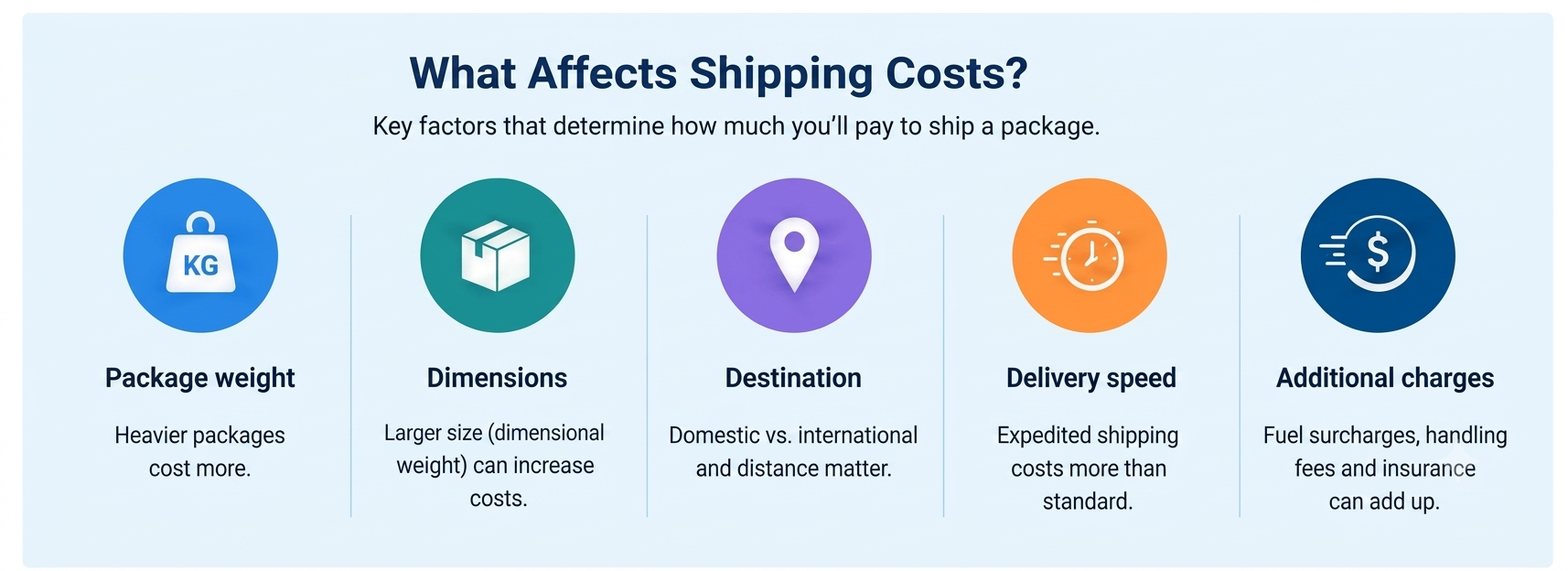
A carrier’s base postage is only one part of the bill. Depending on the service and package, your total may include:
- Base postage: The starting price, affected by service, weight, destination zone, and your rate tier.
- Residential delivery fees: UPS and FedEx may charge extra for delivery to a home. The fee depends on the service and rate arrangement.
- Delivery-area fees: Some destinations carry an additional charge. Carriers update the affected ZIP codes and fee schedules.
- Fuel surcharges: UPS and FedEx apply these according to their published schedules.
- Dimensional-weight and size fees: A large box can cost more than its scale weight suggests.
- Address or measurement corrections: The carrier may bill more if the address or package details need correction.
- Peak-season surcharges: Holiday demand can add fees, especially for residential and oversized packages.
- Your packaging and labor: Boxes, mailers, packing materials, and packing time all have a cost.
- Returns: Return labels and the way you handle returns affect the total cost of fulfillment.
USPS generally doesn’t show a separate residential or fuel fee in the same way UPS and FedEx do. That can make it attractive for some residential deliveries, especially lighter parcels, but you still need to check its postage and dimensional-weight rules.
A practical check: Add up all shipping charges on a month of carrier invoices, including later adjustments, and divide by the number of packages shipped. That gives you a more realistic average cost per order than the price shown when you bought the labels.
What changed in 2026—and why it matters
Several 2026 changes can affect the price you see today. The impact varies by package and rate plan, so use the figures below as prompts to verify your own rates—not as a substitute for a carrier quote.
- UPS and FedEx list rates increased. Their 2026 general rate increases averaged 5.9%, with changes taking effect on December 22, 2025, for UPS and January 5, 2026, for FedEx. That’s an average across services; your actual change depends on the shipment and fees.
- Fractional inches round up. UPS and FedEx have rounded package measurements up to whole inches since August 18, 2025. A side measuring 12.1 inches may be treated as 13 inches.
- Size-based surcharge rules changed. Reported 2026 changes added cubic-volume triggers for some FedEx and UPS size surcharges. Thresholds and effective dates can depend on the fee, so check each carrier’s current surcharge guide before relying on a specific cutoff.
- USPS changed prices in January. The January 18, 2026, changes varied by weight. Pirate Ship reported that some 10–20 lb Ground Advantage parcels became cheaper, while lightweight parcels saw increases on average. Check the current USPS price list for your package.
- USPS introduced a temporary increase. An 8% increase on base postage for Priority Mail Express, Priority Mail, Ground Advantage, and Parcel Select began April 26, 2026, and is scheduled to run through January 17, 2027. USPS said it would decide in January whether a different longer-term approach is needed.
- USPS changed dimensional and commercial pricing rules in July. From July 12, 2026, USPS adopted a 139 dimensional-weight divisor, began rounding fractional inches up, and removed ounce-based pricing for published commercial Ground Advantage under 1 lb. A $3 dimension noncompliance fee was also reported. Check USPS’s current rules and the rates your shipping tool displays.
- Holiday surcharges are in effect. UPS, FedEx, and USPS schedules include seasonal charges or price changes. See the peak-season section below and confirm the dates and fees for your service.
Bottom line: If you’re using last year’s rate comparison—or a quote from before July—rerun it using current prices and package rules.
Step 1: Get to know your shipping profile
Before switching services or negotiating rates, look at what you actually ship. Export around 90 days of orders and group them by:
- Package weight and dimensions, both as measured and as entered when you bought the label
- Destination ZIP code or shipping zone
- Residential or commercial delivery
- Carrier and service
- Label price and final invoiced cost, including adjustments
Then look for two things:
- The gap between label prices and final charges. This can reveal measurement corrections, address fees, or surcharges you weren’t accounting for.
- Your highest-cost shipments. Sort by cost per order and review the most expensive 10%. A few product types, large boxes, or distant destinations may be driving a disproportionate share of your spend.
You don’t need to change your whole shipping setup at once. Start with the package types and routes that account for the biggest costs.
Dimensional weight: when a light package costs more than expected
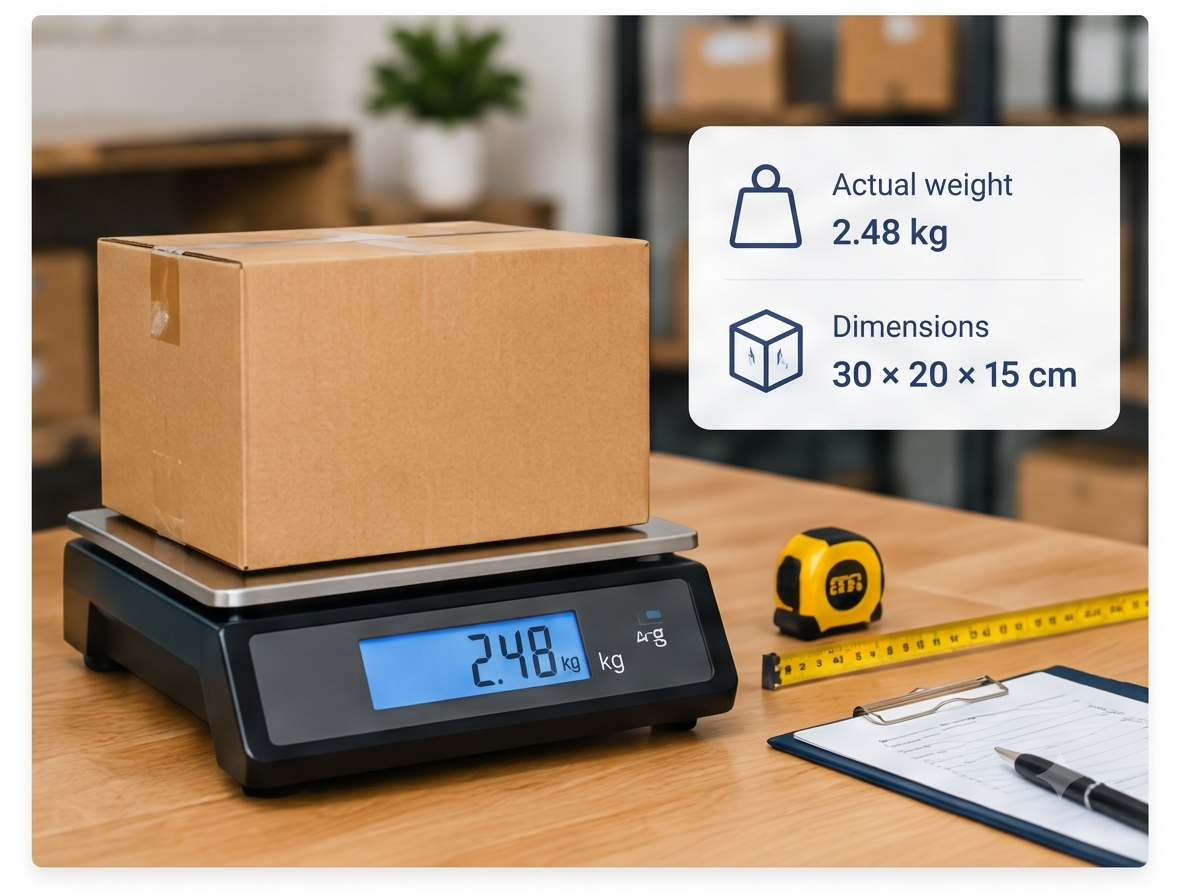
Carriers may price a package using its dimensional weight—a calculation based on the box’s size—instead of its actual weight. In general, the billable weight is whichever is greater: scale weight or dimensional weight.
The basic formula is:
Length x width x height ÷ dimensional-weight divisor
The result is rounded up to the next whole pound. UPS and FedEx use a 139 divisor for most packages. USPS applies dimensional weight to packages over 1 cubic foot (1,728 cubic inches); since July 12, 2026, it also uses a 139 divisor. Check the current rules for the specific service you use.
Two examples
Example 1 : A 2 lb item ships in a box measuring 11.1 x 8.4 x 6.2 inches with UPS or FedEx. With fractional inches rounded up, the box is treated as 12 x 9 x 7 inches. That is 756 cubic inches; 756 ÷ 139 = 5.44, which rounds up to a billable weight of 6 lb—not 2 lb.
Example 2 : A 3 lb item ships with USPS in a box measuring 12.5 x 12 x 12 inches. Rounded up, that is 13 x 12 x 12 inches, or 1,872 cubic inches—over the 1,728-cubic-inch threshold. Dividing by 139 gives 13.47, or a billable weight of 14 lb. A box measuring exactly 12 x 12 x 12 inches is at the one-cubic-foot threshold, so verify the service’s current rule before assuming dimensional weight does or doesn’t apply.
The takeaway: a small change in box size can move a package into a different pricing band. Measure the boxes you use and enter accurate dimensions when you buy labels.
Ways to keep dimensional costs down
- Use the smallest box that safely protects the item.
- Reduce excess void fill where it’s safe to do so.
- For USPS, check whether keeping the package at or under 1,728 cubic inches avoids dimensional pricing for your service.
- Watch out for boxes close to carrier size thresholds. Even a small change in a side measurement can affect the charge.
- Consider a poly mailer for suitable soft goods. It can reduce volume, but it may not protect fragile products well—test it before changing packaging across a product line.
USPS Ground Advantage Cubic: worth checking for small, dense parcels
Ground Advantage Cubic is a commercial USPS price tier that prices eligible packages by cubic volume and distance rather than weight. It may be useful for compact, heavier items such as books, candles, or supplements.
Eligibility rules matter. Packages generally must be 1 cubic foot or less and weigh no more than 20 lb, with a limit on the longest side. Published explanations have differed on the exact longest-side limit after the July 2026 changes; check the current Domestic Mail Manual, section 283, before you rely on a particular measurement.
Cubic pricing isn’t automatically cheaper. It uses volume tiers, so a small change in box dimensions can move the package into a higher tier. Quote both cubic and weight-based Ground Advantage for the same package. For very light parcels, standard commercial pricing may be less expensive.
Retail, commercial, and negotiated rates
The same shipping service can cost different amounts depending on how you buy it:
- Retail rates: The prices you pay at a carrier counter. They may be higher than rates available online.
- Commercial rates: Discounted USPS prices available through qualifying shipping software or other approved channels.
- Negotiated account rates: UPS or FedEx rates based on an account agreement. Discounts and terms vary; don’t assume a discount is available until you see it in your account or contract.
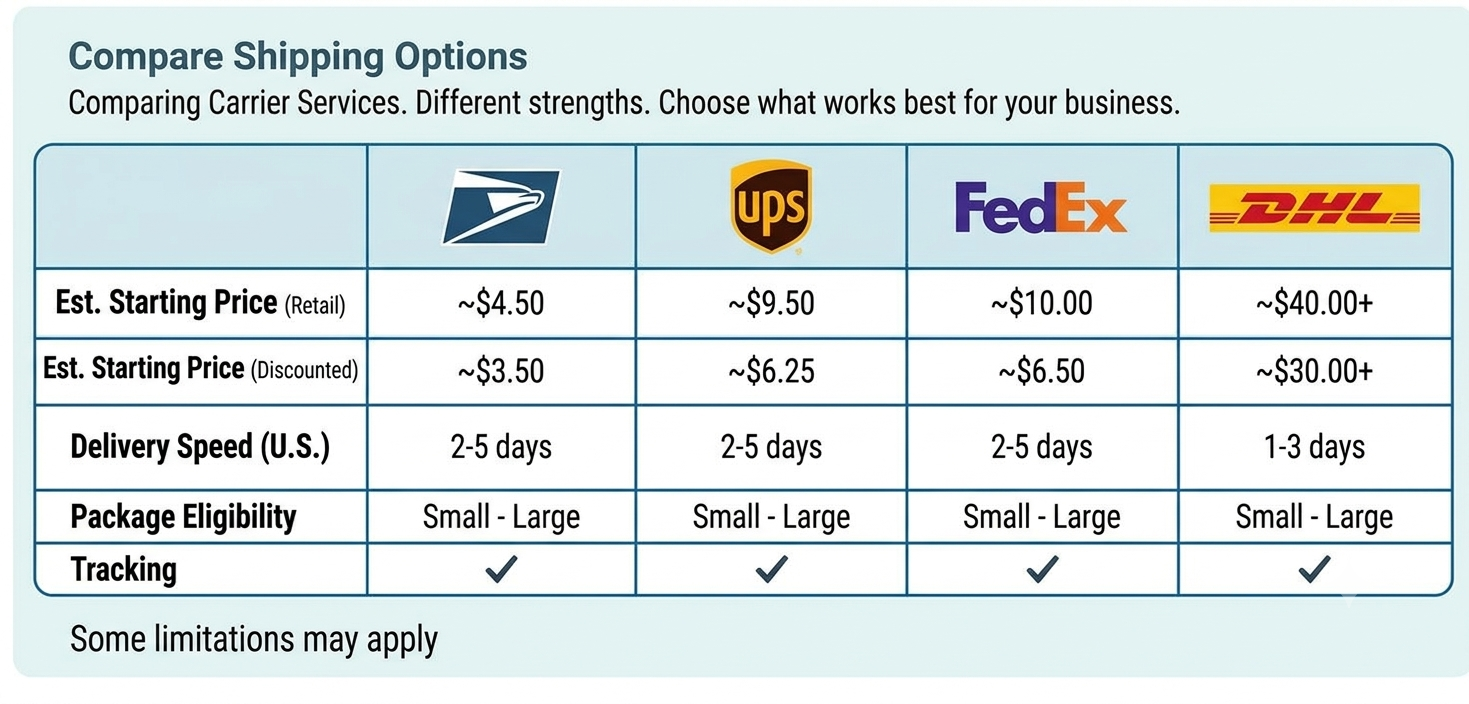
For example, one July 2026 comparison reported USPS Ground Advantage starting at 5.50 commercially. Those are vendor-reported starting prices, not a promise of what your package will cost. The actual price depends on weight, destination, package details, and the rate source.
If you currently buy labels at the counter, checking commercial options may be a simple first step. If you already have discounted rates, compare them against other available services using your own package data.
Using multi-carrier shipping software
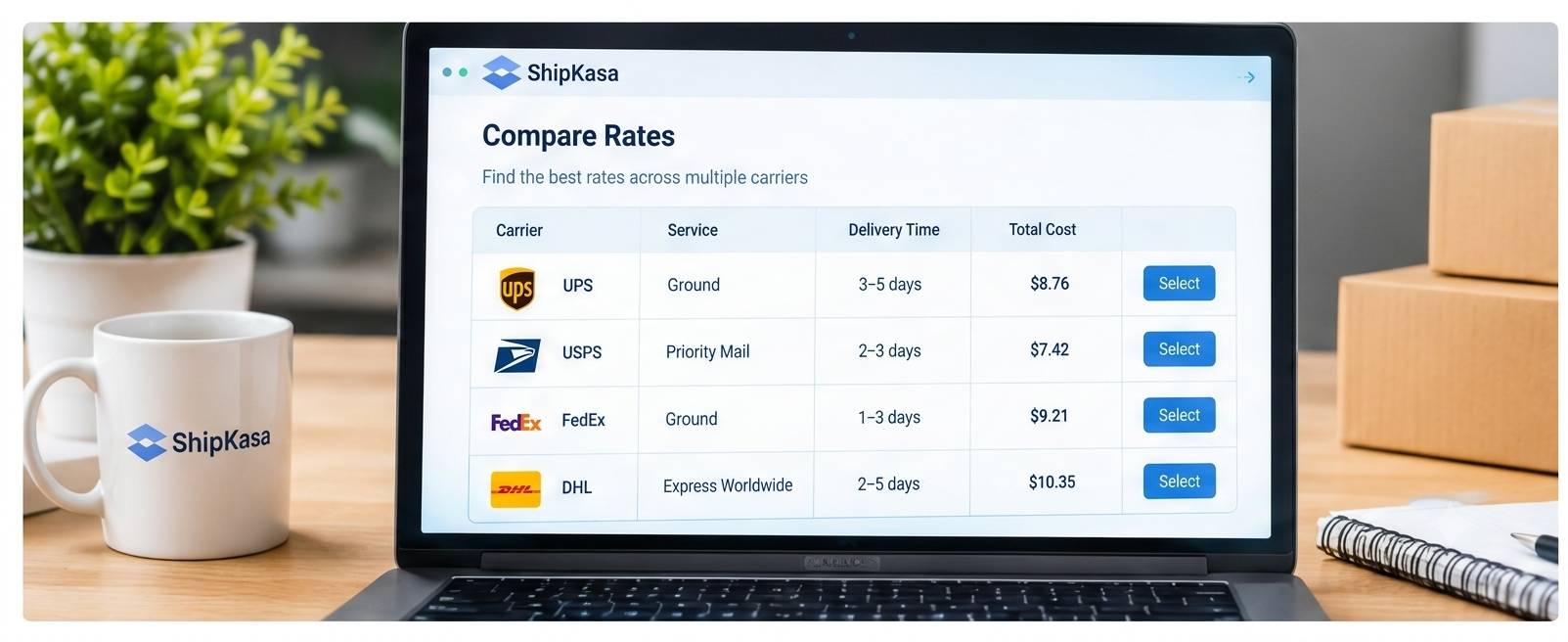
Multi-carrier shipping software can let you compare services, buy labels, and manage shipments in one place. It may also give you access to commercial rates. A tool doesn’t lower costs automatically: the savings depend on the rates available to you and whether you choose the right option for each order.
For example, ShipKasa offers integrations for USPS, UPS, FedEx, DHL, and OnTrac. When evaluating any shipping tool, ask:
- Which carriers and services are included? Are the prices discounted platform rates or my own account rates?
- Are there monthly, per-label, or markup fees?
- Does it show cubic pricing where eligible?
- Does it rate packages using the rounded dimensions carriers actually use?
- Does the quote include estimated residential and delivery-area fees, or only the base rate?
- Are the 2026 USPS pricing changes reflected in the rates shown?
- How do unused-label refunds and carrier adjustment disputes work?
A useful tool should make it easier to compare the same order across services and understand what’s included in each quote.
Surcharges and invoice adjustments to watch
Three common surprises can make the final invoice higher than the label price.
Residential and delivery-area fees
UPS and FedEx may add fees for deliveries to homes and certain ZIP codes. For direct-to-consumer sellers, residential fees can be a routine part of shipping—not an unusual exception. Compare the full cost for the destination, not just the base postage.
Address corrections
If a carrier corrects an address, it may charge a fee. Reported 2026 amounts can exceed $20 per package, but the exact charge depends on the carrier and service. If your checkout or order tools support address validation, use it before buying the label.
Measurement corrections
Carriers may remeasure a package in transit. If the carrier’s dimensions produce a higher billable weight than you entered, it may charge the difference later. Keep a record of your box sizes, use accurate measurements, and check invoice adjustments against your records. If you believe a correction is wrong, follow the carrier’s dispute process and provide evidence.
Rather than relying on broad estimates about how often invoices contain errors, review your own bills and track the adjustments that actually affect your shipments.
Peak-season surcharges: check your costs before holiday volume hits
Holiday demand charges can stack on top of regular postage and other fees. The schedule below is based on 2026 announcements and reporting; confirm the current carrier schedule and the services it applies to.
Carrier | Reported surcharge start | Residential demand charge begins | Reported season end |
UPS | September 27, 2026 | October 25, 2026 | January 16, 2027 |
FedEx | September 28, 2026 | October 26, 2026 | January 17, 2027 |
USPS | October 4, 2026 | Not applicable in the same way; temporary holiday prices apply | January 17, 2027 |
Supply Chain Dive reported UPS residential demand surcharges of around 2.50 per package, depending on the period, and FedEx residential Ground and Home Delivery demand charges of around 0.80. Oversized and large packages can face much higher demand charges. These are reported figures, not a substitute for checking the carrier’s current schedule.
Before holiday volume ramps up:
- Recalculate your average cost per order using peak-season fees.
- Check whether fees apply to economy services you expect to be cheapest.
- Avoid unnecessary package size increases, especially near surcharge thresholds.
- Review free-shipping thresholds and flat shipping fees against your current costs—not last year’s.
Economy services and regional carriers
UPS Ground Saver and FedEx Ground Economy are lower-priced options intended for some less-urgent residential shipments. They may trade delivery speed or tracking details for a lower price. Check transit estimates, tracking behavior, eligibility, and peak-season fees for the routes you actually ship.
Regional carriers such as OnTrac may offer competitive rates or delivery times within their coverage areas. Their service areas, fees, and claims processes differ, and coverage can change. Compare quotes using real origin and destination ZIP codes before shifting volume.
Could shipping closer to your customers save money?
Shipping cost generally rises with distance, often represented by a carrier’s shipping zone. If many orders travel a long way from your warehouse, holding some inventory closer to customers could reduce postage or delivery time. But a second location brings its own costs, so run the numbers first.
A simple monthly estimate is:
Potential monthly benefit = orders affected x postage saved per order x added storage and handling, transfer freight, extra safety stock, and fulfillment fees
Illustration only: If 600 monthly orders would save 1,200. If the added costs of a second location total 300. Your result will depend on your own order mix and operating costs.
Also consider the extra inventory needed, the risk of stockouts at one location, replenishment freight, and the time it takes to manage another site or fulfillment partner.
Make sure the shipping price you charge still makes sense
Your carrier costs may have changed during 2026. Review what customers pay for shipping alongside what you pay to fulfill their orders:
- Compare average shipping cost per order—including surcharges and adjustments—with shipping revenue collected.
- Revisit free-shipping thresholds and flat rates using current costs.
- Where it makes sense, account for products or destinations that cost more than average, such as heavy items, remote ZIP codes, or oversized boxes.
- Remember that the USPS temporary increase is scheduled through January 17, 2027. What happens afterward is not yet known, so avoid pricing decisions that rely on an unannounced change.
A practical 30-day shipping-cost review
Week 1: Build your baseline. Export 90 days of orders and shipping charges. Group by weight, zone, package size, and residential or commercial delivery.
Week 2: Find the surprises. Compare label prices with final invoices. List adjustments, address corrections, and surcharges. Check that the dimensions in your shipping system match your actual boxes.
Week 3: Compare real options. Choose representative orders from your biggest shipping categories. Quote them across at least two eligible services, including cubic pricing where applicable. Compare the total expected cost, not just base postage.
Week 4: Test one improvement. Try a smaller box or a different service on one product line. If the results hold up, update your shipping prices or thresholds. Set a reminder to review USPS pricing again after the January 2027 decision.

Frequently asked questions
What is the cheapest way to ship a package in the U.S.?
There isn’t one cheapest carrier for every package. USPS Ground Advantage at a commercial rate is a useful starting point for many light residential shipments. Small, dense packages may qualify for Ground Advantage Cubic, while heavier parcels or business deliveries may be worth comparing with UPS or FedEx Ground. The best way to know is to compare current all-in quotes for your package and destination.
What is the cheapest way to ship a package under 1 lb?
Start by checking USPS Ground Advantage at a commercial rate, then compare other eligible economy options. Since July 12, 2026, published commercial Ground Advantage rates no longer price by the ounce for packages under 1 lb. The price shown can vary by rate source, so check what your own shipping tool or account offers.
Is USPS cheaper than UPS or FedEx?
Sometimes, but not always. USPS can be competitive for lighter residential packages, partly because its pricing doesn’t show a separate residential fee in the same way as UPS and FedEx. Larger boxes, heavier packages, business destinations, or account discounts can change the comparison. Check the total cost for your shipment.
Why is my shipping invoice higher than my label price?
Common reasons include dimensional-weight adjustments, address corrections, residential or delivery-area fees, and peak-season charges. Compare a month of label prices with final invoice charges to find the causes that matter for your shipments.
What is the cheapest way to ship a heavy package?
Compare the current rates available to you across eligible services. Ground Advantage Cubic is limited by weight and dimensions, while USPS Ground Advantage may still be competitive for some packages in the 10–20 lb range. UPS or FedEx Ground account rates may work better for other weights, zones, and box sizes. There is no universal break-even point.
Will shipping get cheaper after January 2027?
It’s too early to know. The USPS temporary 8% increase is scheduled to end January 17, 2027, and USPS has said it will decide whether to use a different longer-term approach. Don’t assume prices will fall; plan for more than one possibility and review rates when the next announcement is available.
Does multi-carrier shipping software lower shipping costs?
It can help you access available rates and compare services for each package, but it doesn’t guarantee savings. Check which rates are included, what fees the software charges, and whether its quotes account for dimensions and surcharges.
Sources and where to verify current rules
Carrier rules and prices change, so confirm any figures before publishing them or using them to set customer-facing rates. This guide draws on carrier documents and third-party reporting; third-party figures are identified as such in the text.
- USPS Notice 123 and the current Domestic Mail Manual, including section 283 for Ground Advantage Commercial.
- USPS newsroom announcements on 2026 price changes, including the temporary increase and July competitive-price changes.
- Current UPS and FedEx rate guides, surcharge pages, and demand-surcharge schedules.