How Discounted Shipping Rates Work (Without Volume Commitments)
November 03, 2026 12 min read
Get discounted shipping rates with no minimums. Compare USPS commercial pricing, FedEx, UPS and platform rates by total cost, and avoid hidden fees.
Most businesses don’t pay the price printed on a carrier’s rate sheet. What you pay depends on how you buy the label, whose account it runs through, and what the carrier knows about the shipper behind it. A discounted shipping rate is a lower price tied to one of those arrangements: a published commercial rate for labels bought online, an account-level discount, or pricing that a shipping platform passes through to its users.
You don’t need a volume contract to get some of these. Small shippers usually reach them in one of three ways: USPS commercial pricing, a carrier account with no minimum, or a shipping platform’s rates. What they usually can’t get are the deeper, custom discounts carriers negotiate with shippers who can commit to volume. One thing to know before the details: a discount usually applies to the base transportation charge, not the whole invoice. Residential delivery, delivery-area, fuel and oversized-package charges can change which option is actually cheapest, so much of this guide is about comparing total cost per package rather than discount percentages. This guide is part of our series on setting shipping rates for your online store, which covers the wider pricing picture.
Carrier prices and programs change. Confirm current terms with each carrier before relying on any figure here.
Why carriers discount some shippers more than others
Carriers price an account based on its volume and its shipment profile: how much it ships, how heavy and large the packages are, whether they go to homes or businesses, and which zones they travel to. A shipper with steady, predictable volume and a profile that suits the carrier’s network is generally in a stronger position to negotiate than one sending a handful of parcels a week.
What a volume commitment is
A volume commitment is a shipment or revenue threshold written into a carrier agreement. Meet it and the discount holds. Miss it and the carrier can re-rate the account or move it to a worse tier. The exact terms vary by contract.
Types of shipping rates: retail, commercial, platform and negotiated
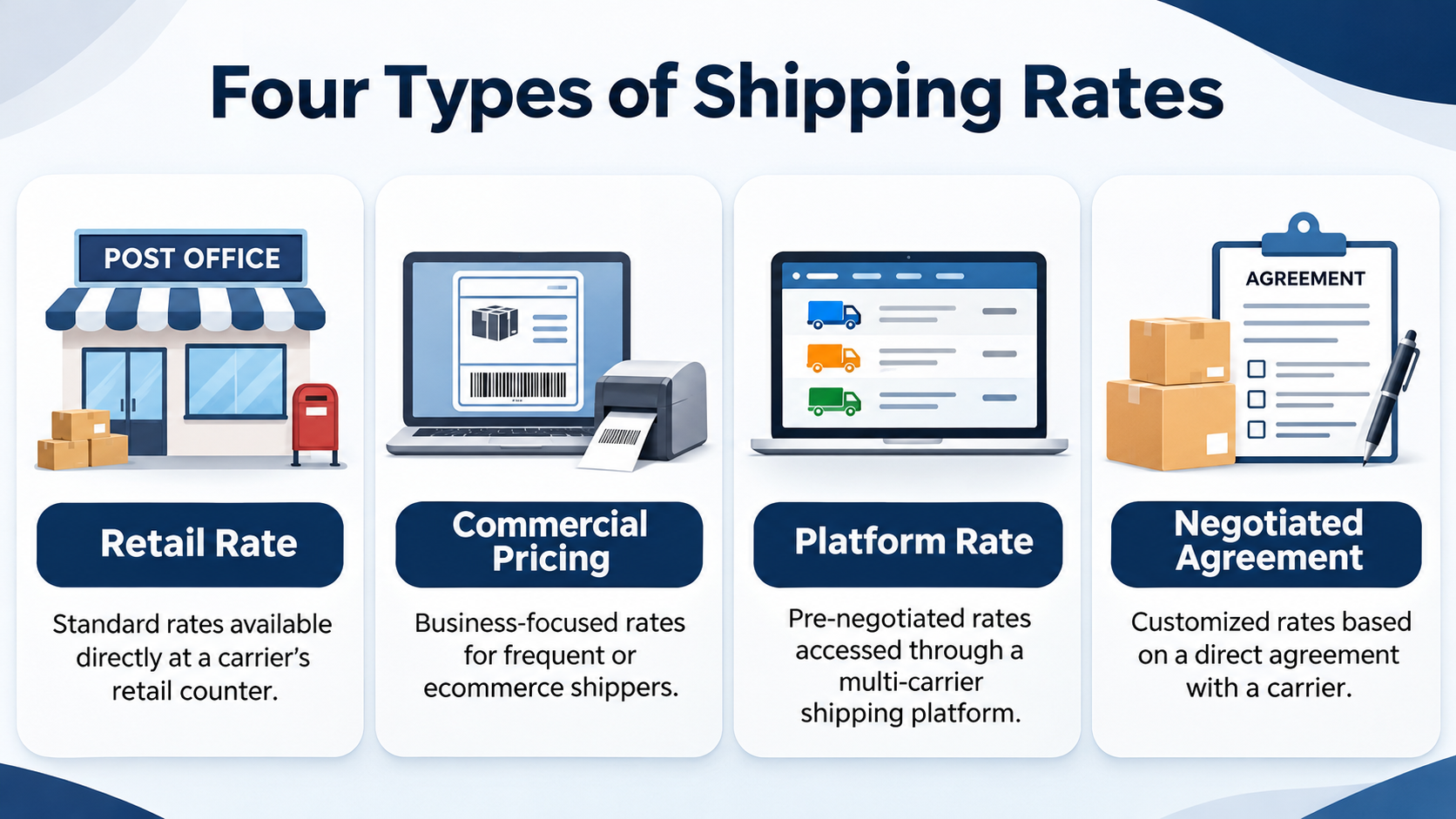
Type | What it is | Who typically gets it | Main condition |
Retail rate | The highest published price, usually paid at a carrier location or without an account discount | Anyone | None |
Commercial pricing | A published, discounted tier for electronically purchased postage or eligible account shipments | Online shippers and account holders | Buying labels electronically or through an eligible account |
Platform (pooled) rate | Pricing a shipping platform or marketplace passes to its users | Users of that platform | The platform’s terms, which can change |
Negotiated agreement | A custom contract with a carrier, such as a USPS Negotiated Service Agreement | Shippers with consistent, larger volume | A volume commitment |
“Discounted” and “negotiated” are not the same thing, but the line is less clean than it looks. Published commercial pricing and standard account discounts are open to anyone who meets simple conditions, so you don’t negotiate them. Platform rates, though, generally come from an arrangement between the platform and a carrier, which means you’re using terms someone else secured. USPS documents one example: its USPS Connect eCommerce program lets participating platforms obtain discounted Merchant Rate Card pricing to pass on to merchants. Other platforms’ arrangements may differ, which is why the provider questions later in this article matter.
Three ways to get lower shipping rates without a commitment
USPS commercial pricing
USPS commercial pricing is published, not individually negotiated. Labels bought electronically, through Click-N-Ship or shipping software, are priced lower than the same parcel at a Post Office counter. As an example, USPS lists Priority Mail starting at $11.50 at the Post Office versus $9.44 with commercial pricing, and Ground Advantage starting at $8.40 at a counter, with lower commercial rates online. Those are “starting at” prices for the lightest, nearest shipments, and USPS adjusts its prices periodically, so check the current price list instead of treating them as typical.
For the parcel services most online sellers use, USPS doesn’t require a volume commitment. That doesn’t make USPS a no-minimums carrier across the board. Some commercial mail categories do have minimum quantities, such as 500 pieces for presorted First-Class Mail and 50 pieces per mailing for Parcel Select Destination Entry. Those are different products from the labels a typical online store buys.
Commercial pricing also doesn’t remove extra fees. Nonstandard packaging fees, dimension-related penalties and dimensional-weight rules can still apply.
Carrier accounts
FedEx states that no minimum package volume is required to open an account or receive its built-in account discounts, and that sellers on platforms such as Etsy and eBay qualify for a business account regardless of quantity or frequency. Its published small-business examples cite savings of up to 40% on select Express services and up to 20% on select Ground and Home Delivery services.
The words “up to” carry a lot of weight. Discounts usually vary by service, weight break, zone and sometimes surcharge, so those figures describe the best case on select services, not what a given shipper will see. FedEx also notes that additional account discounts don’t apply to FedEx One Rate pricing.
“No minimum” also doesn’t mean “no conditions.” FedEx’s built-in account discounts have no volume requirement, but its partner, alliance, rewards and deeper-discount programs can have separate eligibility criteria.
Shipping platform rates
Shipping software and marketplaces often offer discounted rates through their own carrier arrangements. Many describe this as the result of pooling many merchants’ volume. That is common industry practice rather than a published carrier guarantee, and the details differ from platform to platform.
What you get:
• Lower base costs before you have enough shipment history to negotiate directly
• The ability to print discounted labels from day one
• A side-by-side view of USPS, UPS and FedEx options for the same package
• Room to change carriers, services or packaging as your orders change
What you give up:
• Control of the rate card. The platform can change rates, eligibility, or which carriers and services it offers, and you usually have little say.
• Leverage. You typically have less influence over surcharges, pickup terms, claims handling and service guarantees.
• Possibly some of the saving. Check whether the platform charges its own fees on top of the carrier rate.
These rates are the simplest first step for new, seasonal or fast-changing sellers, and for shippers sending many lightweight residential parcels. A direct carrier account can come out ahead for heavier shipments, commercial destinations or particular zones.
Why a bigger discount doesn’t always mean a lower price
The number worth comparing is what a package costs in total, after every charge. Here is a made-up example. The numbers are invented to show the pattern and are not carrier quotes.
Same package, same home address | Service A | Service B |
List base rate | $10.00 | $9.00 |
Discount on base rate | 30% | 15% |
Base rate after discount | $7.00 | $7.65 |
Residential surcharge | $4.00 | $0.00 |
Total (before fuel and other charges) | $11.00 | $7.65 |
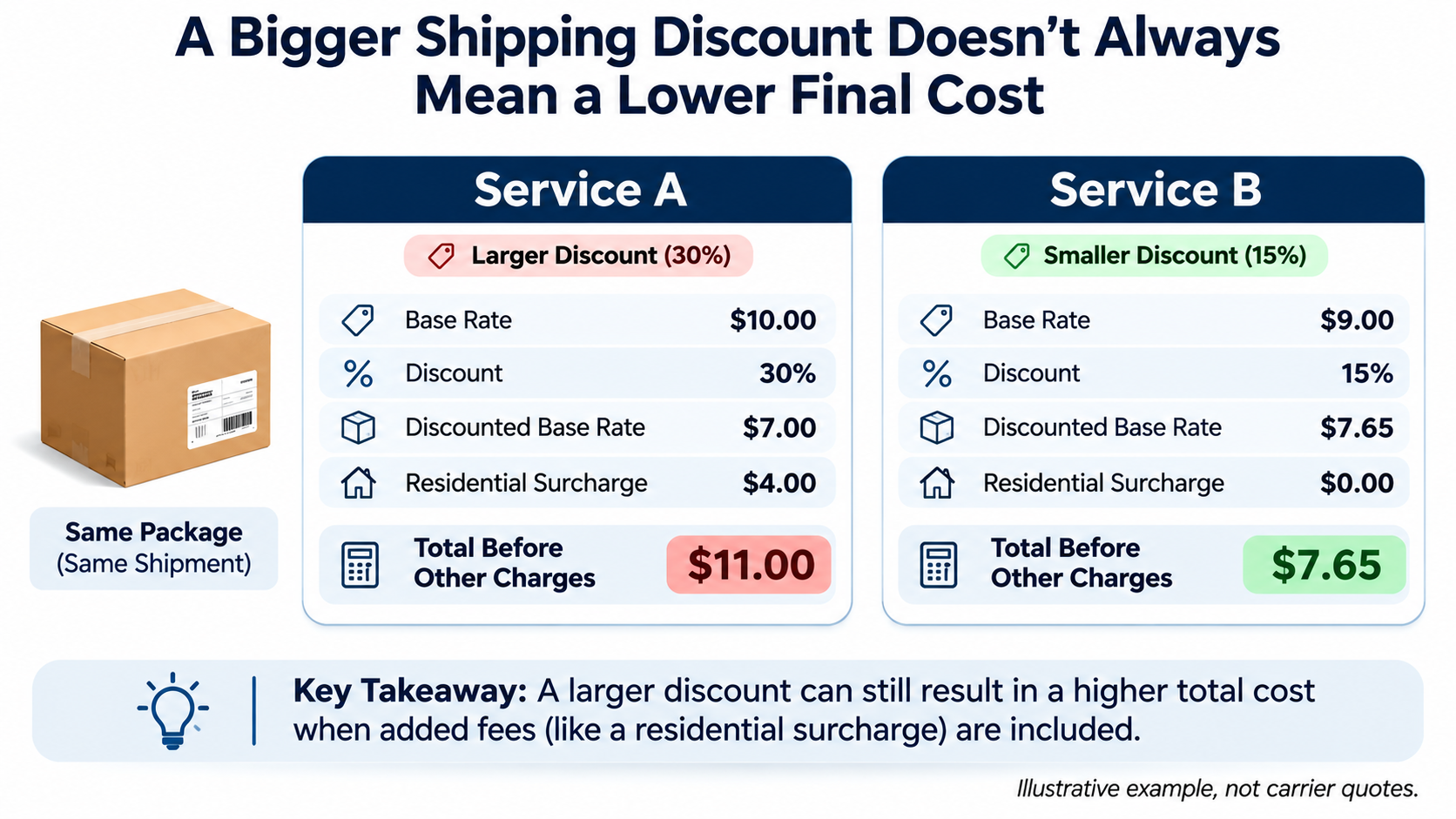
Service A has the bigger discount and the higher bill. The example assumes the discount doesn’t reach the surcharge. Whether it does depends on the carrier, the service and the terms. FedEx, for one, says its built-in account discounts can cover certain surcharges, though not all of them, so read what your account actually includes.
The result can flip in the other direction too. For heavier cartons, deliveries to business addresses or particular zones, a direct account can beat a platform rate. A platform rate can win on a light home delivery and lose on a 20-pound carton to a commercial address, which is why one package profile shouldn’t decide for all of them.
The label price isn’t always the final price
The rate shown when you buy a label is a starting point. UPS’s terms state that residential and delivery-area surcharges apply based on the actual delivery address and designated ZIP codes, in addition to other charges. UPS also charges an address-correction fee when it has to secure or complete an incorrect or incomplete address, and an address that UPS has validated can still be incomplete for delivery. Other carriers have comparable adjustments, such as reroutes and residential reclassifications.
How to get UPS shipping discounts without a volume contract
Does opening a UPS account get you a discount?
FedEx states publicly that its built-in account discounts have no volume minimum. UPS may be different, so don’t assume it matches. Before you decide, check UPS’s current small-business pages, or ask a UPS representative directly what an account without a commitment includes: which services, which charges the discount covers, and what changes if your volume changes.
A related caution. “UPS discount rate” means different things to different people: a percentage off published rates under your own account, or a rate offered through a platform. When you see a figure quoted, ask what it’s a percentage of, which services and charges it covers, and what it assumes about weight and zone. A single “UPS discount” number with none of that attached isn’t something you can plan around.
Ways small shippers reach UPS pricing
• Your own UPS account. You get direct control and your own claims relationship, and you’re exposed to the surcharges described above.
• UPS rates through a shipping platform. This can make sense when you want comparison and flexibility, with the trade-offs covered earlier. Check which UPS services the platform includes.
• A different carrier for some parcels. For light residential orders, USPS commercial or platform rates may come out lower once residential charges are counted, which is the comparison the example above illustrates. It isn’t true for every package.
Many multi-channel brands keep direct UPS and FedEx accounts for control and claims handling, and use USPS or platform rates for lightweight residential parcels.
When negotiating directly with UPS makes sense
Direct negotiation tends to make sense when your volume is consistent and forecastable, surcharges are a major share of your costs, or you need custom service or claims terms. We can’t give you a volume figure that qualifies, and you should be wary of anyone who offers one without a source.
Negotiating well takes data. Keep clean records of carrier, service, zone, weight, dimensions, destination type, surcharges, on-time performance, claims and cost per order. A profile such as “most of our shipments are 1 to 5 pound residential parcels to nearby zones” (a hypothetical example) lets you negotiate for those specific weight breaks and lanes instead of accepting a generic percentage. Invoice audits help too, since findings such as repeated unexpected handling charges become leverage and can point to packing problems on your side.
International shipping rates: what drives the final cost
The pricing mechanics above describe U.S. domestic shipping. International shipping works differently, and discounts there shouldn’t be assumed to behave like the domestic ones. What can be said reliably is what drives the final cost besides the carrier’s rate:
• The carrier and service you choose
• Package weight and size
• Destination and delivery speed
• Whether duties and taxes are paid by you or by the recipient
• Customs paperwork
• The cost and difficulty of returns
A lower label price can be offset by duties, taxes or a failed delivery, so compare total landed cost, not label price. When you compare options, price the same parcel across several services, confirm what each quote includes, and check restricted items and return handling for your destination.
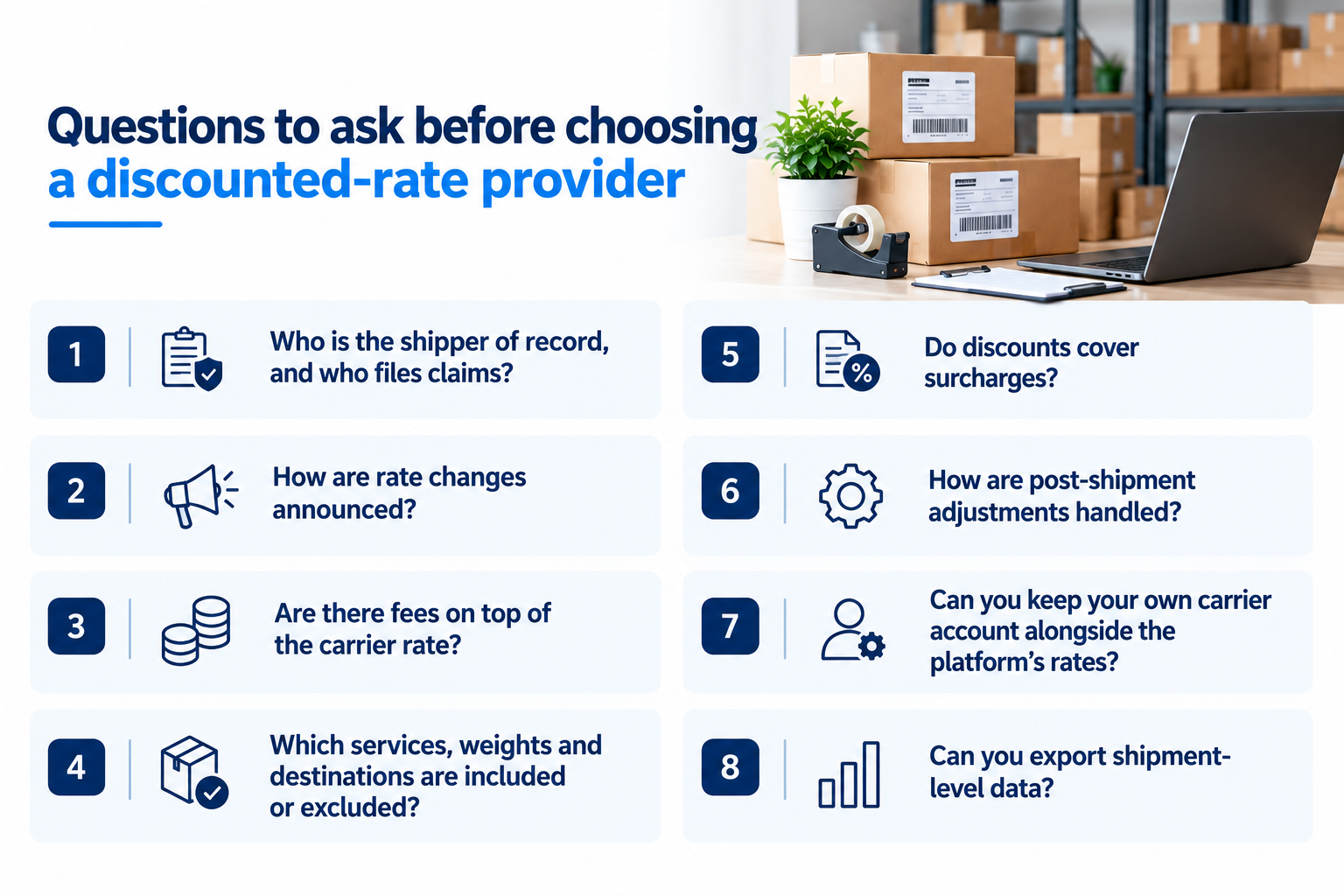
When platform rates stop being enough
It’s time to look at a direct agreement when your volume has become consistent, surcharges are your biggest cost driver, or you need claims or service terms a platform can’t give you. A seasonal business should wait until it has a full year of shipment data before agreeing to anything sized by volume.
FAQ
How do discounted shipping rates work?
A discounted shipping rate is a lower price than the carrier’s retail rate. Small shippers typically get one through USPS commercial pricing, a carrier account or a shipping platform. The discount usually applies to the base transportation charge, not the whole invoice.
Can I get discounted shipping rates without a volume commitment?
Yes, for some of them. USPS commercial pricing for online parcel labels and FedEx’s built-in account discounts don’t require a minimum volume, and shipping platforms offer their rates on the platform’s own terms. The deeper custom discounts carriers negotiate usually do come with a volume commitment.
What is the difference between commercial and negotiated shipping rates?
Commercial rates are published, discounted prices open to anyone who meets simple conditions, such as buying labels electronically. Negotiated rates come from a custom contract with a carrier and usually require a volume commitment.
Are shipping platform rates cheaper than direct carrier rates?
Sometimes. A platform rate can win on a light home delivery and lose on a 20-pound carton to a commercial address, so it depends on weight, destination and zone. Also check whether the platform adds its own fees on top of the carrier rate.
Why can a bigger shipping discount cost more?
Because the discount usually applies to the base rate, not to every charge on the invoice. In this guide’s made-up example, a 30% discount still totals $11.00 once a $4.00 residential surcharge is added, while a 15% discount with no surcharge totals $7.65, both before fuel and other charges. Whether surcharges are covered depends on the carrier and service, so compare total cost per package.
When should a small business negotiate directly with a carrier?
When your volume is consistent and forecastable, surcharges are a major share of your costs, or you need custom service or claims terms. A seasonal business should wait for a full year of shipment data before agreeing to anything sized by volume.