Why Your Team Is Leaving Money on the Table Every Time They Pick a Carrier
July 13, 2026 3 min read
Most eCommerce teams ship with the same carrier every day without questioning whether it's the cheapest option. Real-time rate shopping changes that — automatically selecting the lowest qualifying rate on every shipment, without slowing your team down.
Most eCommerce shipping teams have a default carrier. It's the one they set up first, the one the team knows, the one nobody has questioned in two years. The problem is that shipping with a familiar carrier and shipping with the cheapest carrier are rarely the same thing — and the difference compounds across every shipment you process.
Carrier loyalty without rate visibility isn't a strategy. It's a habit that's quietly draining your margins.
The Real Cost of Picking a Carrier by Default
Default carrier selection doesn't just mean you occasionally overpay. It means you systematically overpay — on every shipment, every day, at whatever volume your operation runs.
A package that qualifies for a lower service level gets shipped at a higher one because nobody checked. A lightweight parcel that should route through USPS goes out on a more expensive carrier because that's what the team always uses. An order heading to a zone where a regional carrier is significantly cheaper goes out on a national carrier because the team doesn't have time to compare.
None of these decisions feel significant in isolation. Across thousands of shipments a month, they add up to a material, measurable cost — one that never shows up as a line item, so it never gets fixed.
What Real-Time Rate Shopping Changes
Real-time rate shopping evaluates every available carrier and service level at the exact moment a label is created. Weight, dimensions, destination, delivery window — the system processes all of it instantly and selects the lowest qualifying rate automatically. Your team doesn't slow down. The decision just gets made correctly every time instead of occasionally.
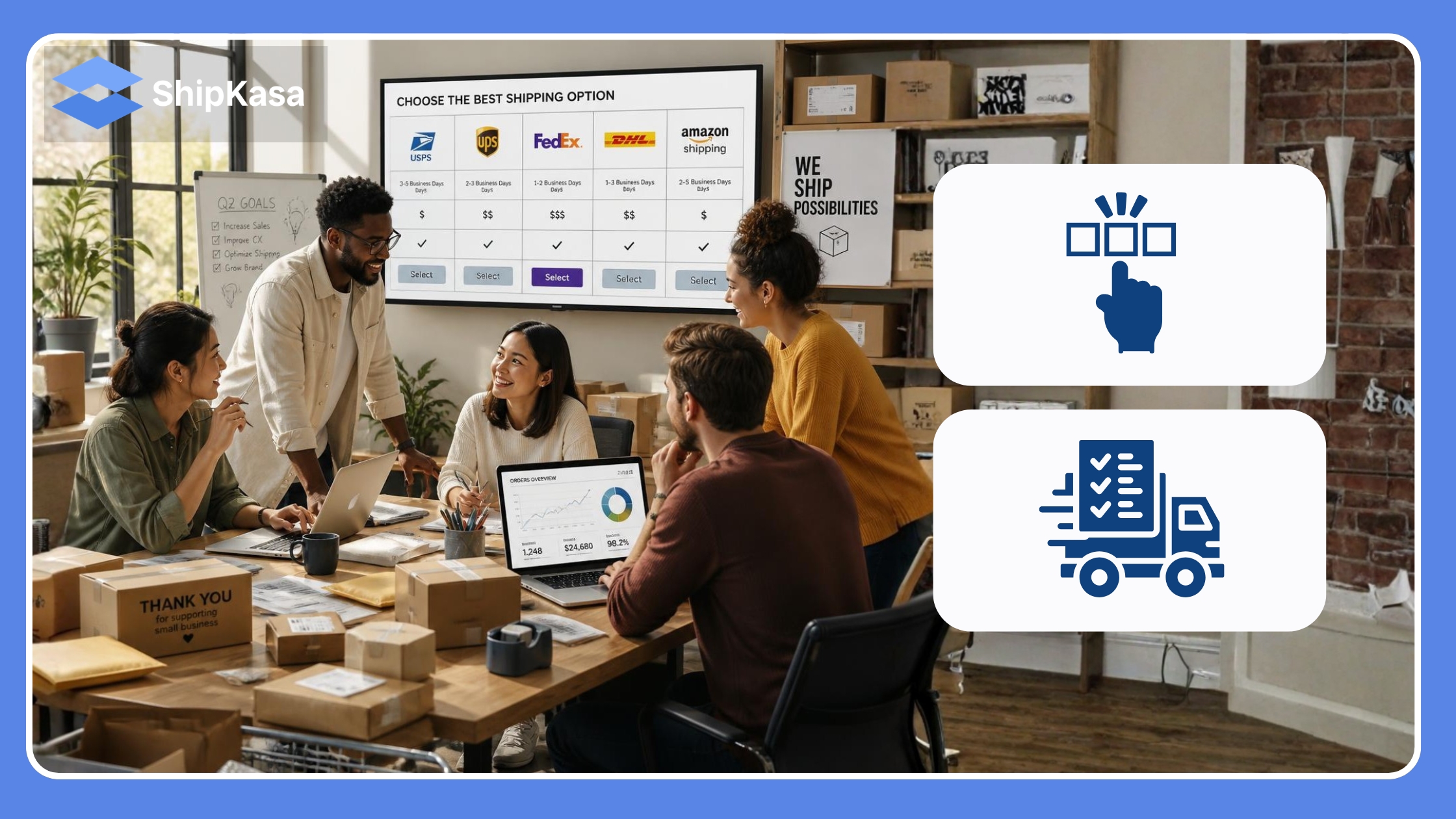
ShipKasa's rate comparison engine runs across USPS, UPS, FedEx, DHL, and OnTrac simultaneously, applying your shipping rules and delivery requirements before selecting a rate. If you've negotiated carrier rates directly, those apply too — ShipKasa's Bring Your Own Carrier model ensures your discounts are factored into every comparison, not just some of them.
The result is that every shipment takes the cheapest route that meets your delivery commitment. Not most shipments. Every shipment.
The same logic applies to shipping methods, not just carriers. Within a single carrier, the difference between service levels can be significant — and most teams never see it because they're not comparing at that level. USPS Cubic Pricing is a clear example: packages that qualify based on size rather than weight can ship at a substantially lower rate than standard Ground or Priority Mail, using the same carrier your team already uses. ShipKasa identifies and applies those method-level savings automatically. Learn more about how USPS Cubic Pricing works and what it could save your operation.
Relief Factor put this into practice and cut their shipping costs by 15% — saving $50,000 every month. That's not a projection. That's what consistent, automated rate optimization looks like at volume.
See What Your Current System Is Costing You
The fastest way to understand what default carrier selection is costing your operation is to run your current shipment volume through a system that actually compares rates. ShipKasa's 7-day free trial connects to your existing carriers and storefronts in minutes — no disruption to your current workflow, no carrier switch required.
Run a batch. Compare the rates. The number tends to be clarifying.
Start your 7-day free trial or schedule a free demo to see real-time rate shopping applied to your operation.